


 by
Your Target Audience
The first step is understanding exactly who your target audience is. Their demographics, purchasing behavior, and decision-making process are closely connected to your brand, service, or product.
Product value plays an important role. Are you selling a relatively inexpensive product that can be purchased quickly, or a high-priced product that requires considerable research before someone makes a decision?
Different audiences also behave differently depending on age, income, interests, and the type of purchase they are considering. Lower-priced products may generate impulse purchases through Social Media, while high-ticket products typically involve a much longer research and comparison process.
For example, Facebook or Instagram might attract a large number of users within your target demographic. However, that does not automatically make them the most valuable marketing channels for your business. If your customers conduct extensive research before making a purchase, Google Search may play a much more important role in the buying process.
Traffic volume alone does not determine the value of a marketing channel. What matters is whether the people using that channel are there with the right intent.
The Research Data
Once you understand your target audience, demographics, and purchasing behavior, the next step is to examine the data.
We first need to understand how the major Social Media Platforms compare with Google Search in terms of overall usage and traffic. But raw visitor numbers only tell part of the story.
More importantly, we need to determine which age groups and demographics use each platform and, above all, why they use it.
Someone browsing Instagram for entertainment behaves very differently from someone searching Google for a specific product, service, solution, or provider. Both may belong to the same demographic, but their intent can be completely different.
For this reason, I have prepared a guide for 2026 that compares the major Social Media platforms with Google Search, showing which age groups use each platform and the primary reasons they use them.
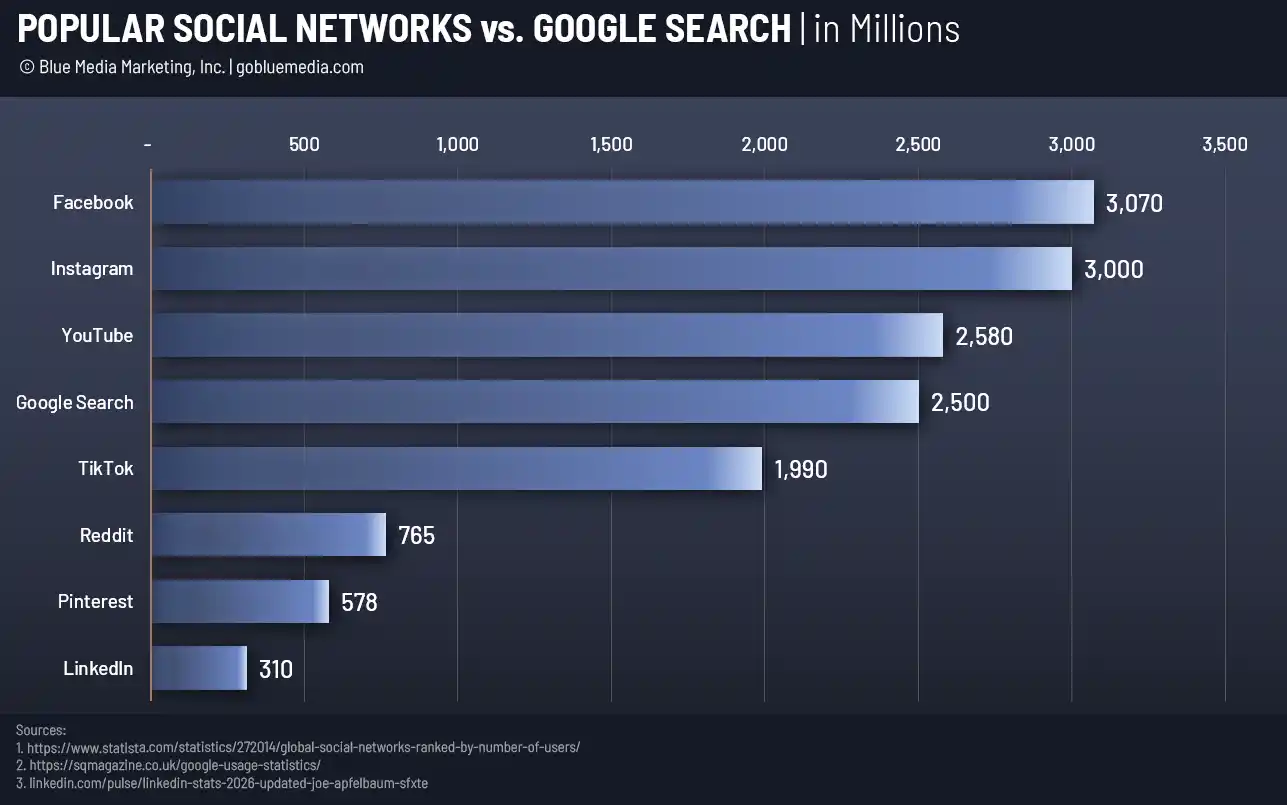
Let’s begin with the simplest comparison: where people in the U.S. spend their time online.
Facebook Demographics 2026
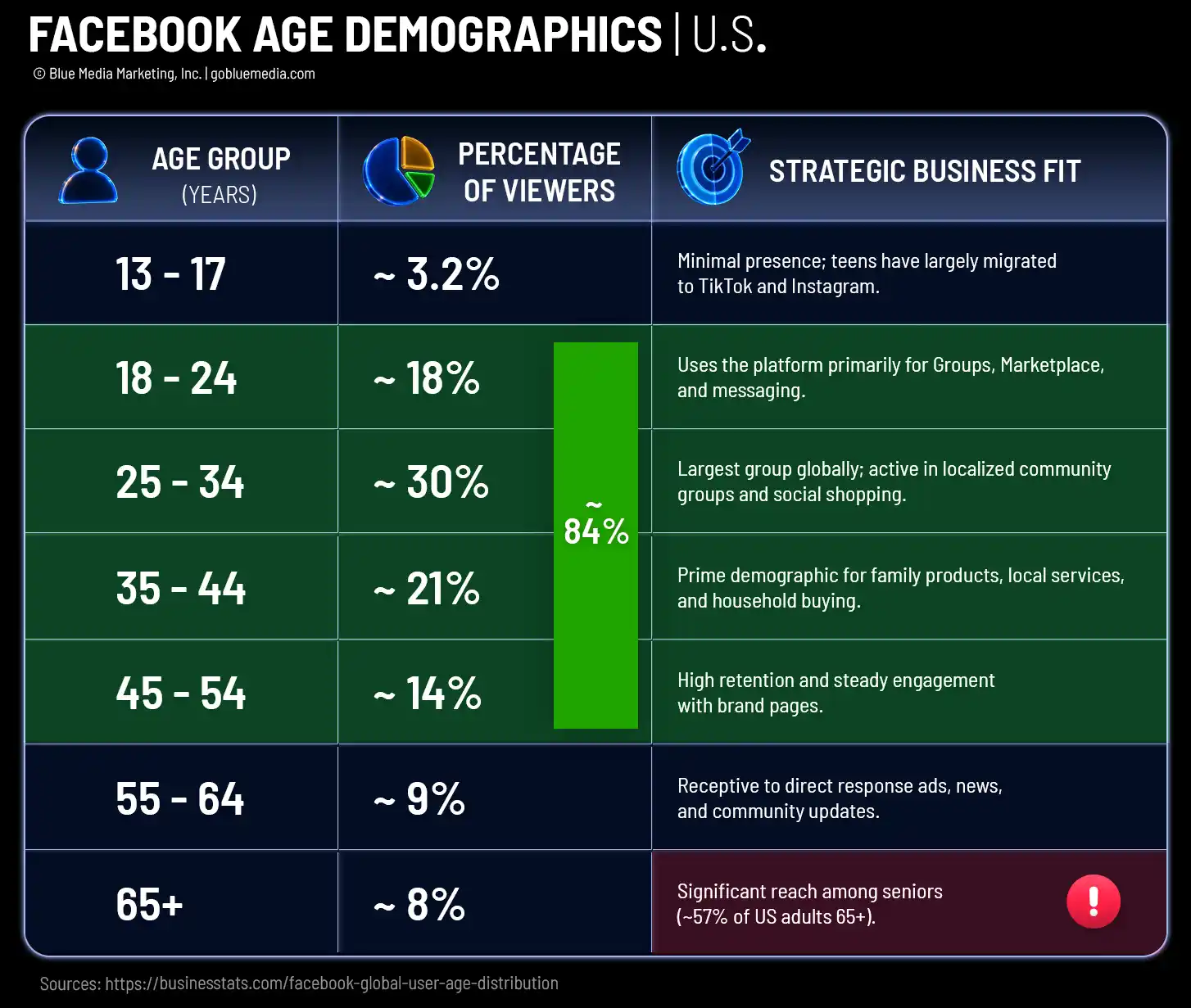
The data illustrates why a business should never choose a social media platform simply because it has a large overall audience. What matters is whether the platform reaches the specific demographic most likely to become a customer.
Facebook, as the most visited social media platform with more than 3 billion users every month, even surpassing Google Search, is heavily concentrated among adults. Roughly 84% of its audience falls within the 18-54 age range.
For businesses targeting established adult consumers, this makes Facebook particularly relevant. Local services, household products, family-oriented businesses, home improvement companies, professional services, and many other businesses whose customers are typically between 25 and 54 may find a substantial portion of their prospective audience on the platform.
The picture changes considerably at the younger end of the market. Users aged 13-17 represent only around 3.2% of the audience shown here, indicating that many younger users have moved to platforms such as Instagram and TikTok. A company primarily targeting teenagers would therefore have little reason to make Facebook its central visibility strategy.
One particularly interesting aspect of Facebook is its meaningful reach among older consumers. Approximately 17% of its audience is age 55 or older, which actually represents about 58% of the adult senior population using Facebook today.
Now, let’s have a look at the other platforms.
Instagram Demographics 2026
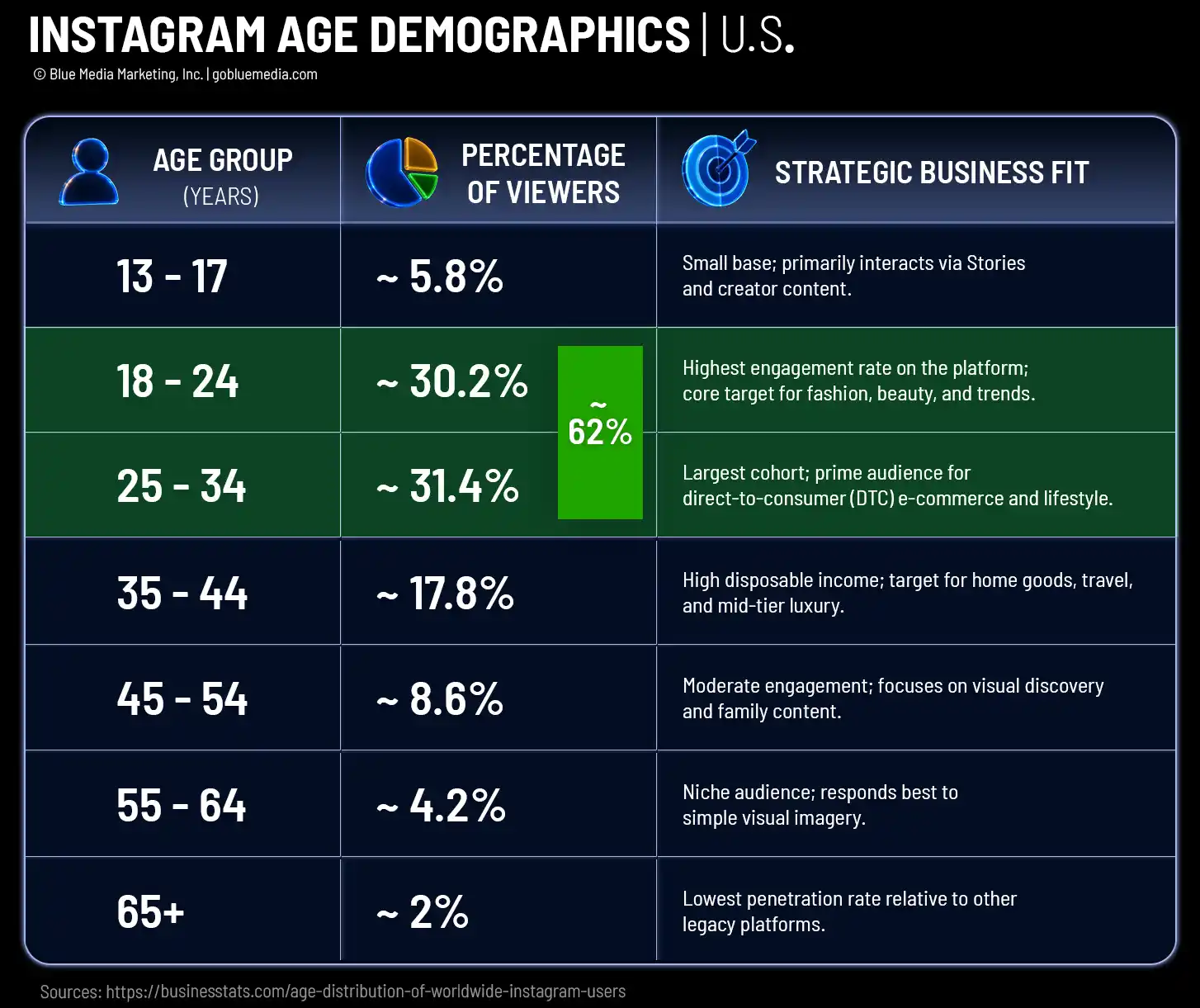
The Instagram demographic data tells a very different story from Facebook. While Facebook is heavily concentrated among established adult consumers, Instagram’s audience is considerably younger, making it particularly relevant for businesses targeting younger adults and lifestyle-driven markets.
The strongest concentration is found among users between the ages of 18 and 34. Approximately 62% of Instagram’s audience falls within these two age groups alone.
For businesses targeting younger consumers, this makes Instagram particularly attractive.
Fashion, beauty, fitness, travel, entertainment, food, lifestyle brands, and direct-to-consumer businesses may find a substantial portion of their prospective customers on the platform. Instagram’s highly visual environment also makes it particularly suitable for products and services where appearance, inspiration, trends, and brand identity strongly influence purchasing decisions.
The picture changes considerably among older demographics. Users aged 45-54 account for approximately 8.6% of the audience, while those aged 55-64 represent only around 4.2%. Users aged 65 and older make up approximately 2%. Businesses primarily targeting retirees or older consumers would therefore be unlikely to find Instagram as attractive as platforms with significantly stronger penetration among these age groups.
The strategic difference between Facebook and Instagram becomes immediately visible. Facebook offers broader access to middle-aged and older consumers, while Instagram is much more heavily concentrated among younger adults. A business targeting consumers between 18 and 34 may therefore find Instagram significantly more relevant, while a company whose typical customer is over 55 would likely reach only a comparatively small portion of its potential market through the platform.
YouTube Demographics 2026
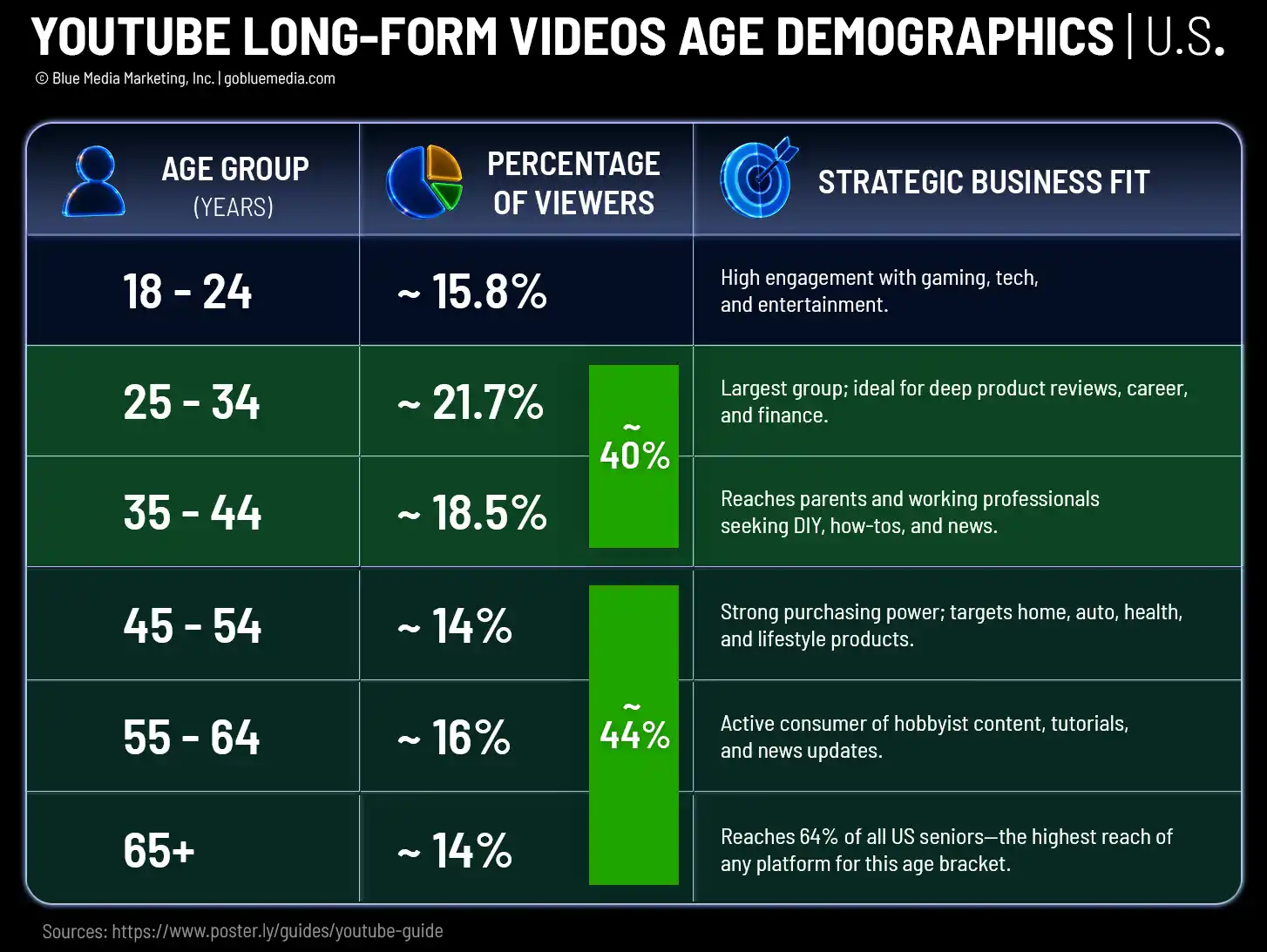
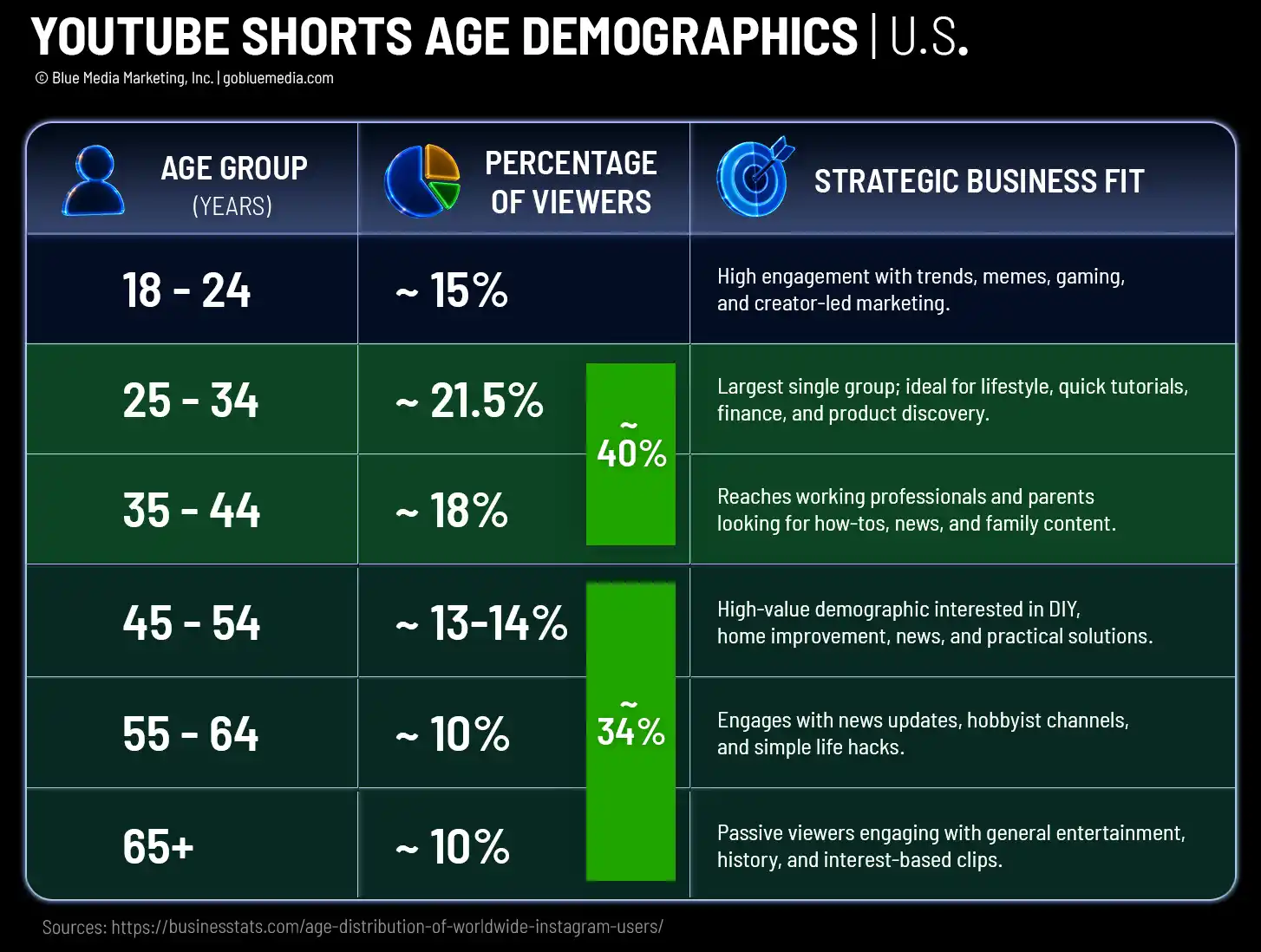
The YouTube data reveals an important insight here. Looking at the data, we can see that both formats, YouTube long-form videos as well as Shorts, show a strong concentration among adults between 25 and 44.
Now, the interesting part about this is that YouTube started to compete against platforms such as Instagram and TikTok with YouTube Shorts. That was its answer to how to reach younger adults. But that didn’t work out for YouTube, as you can see. Even short videos on YouTube ended up reaching adults rather than the younger groups YouTube had hoped for.
What most likely happened is that YouTube was already dominated by adult audiences, and the same audience started consuming Shorts as well once YouTube began offering them. But it did not bring younger people away from Instagram and TikTok and back to YouTube.
This means that whether we are talking about YouTube Shorts or long-form videos, YouTube is a platform for adults. Nearly 34% of YouTube Shorts viewers are 45+, while 44% of YouTube long-form viewers are 45+.
This makes both YouTube formats highly relevant for businesses targeting established adult consumers rather than only teenagers or very young viewers.
This is a significant strategic advantage for businesses targeting mature consumers, homeowners, parents, hobbyists, or high-intent buyers who are more likely to spend time watching in-depth content before making decisions.
For businesses, the takeaway is clear. YouTube Shorts is well suited for visibility strategies focused on quick discovery, entertainment, creator-led promotion, and high-frequency engagement, but still across a broad adult audience.
YouTube long-form videos are particularly valuable when the goal is deeper education, product evaluation, tutorials, reviews, and trust-building with consumers who want more information before acting, but again, primarily among an adult audience.
TikTok Demographics 2026
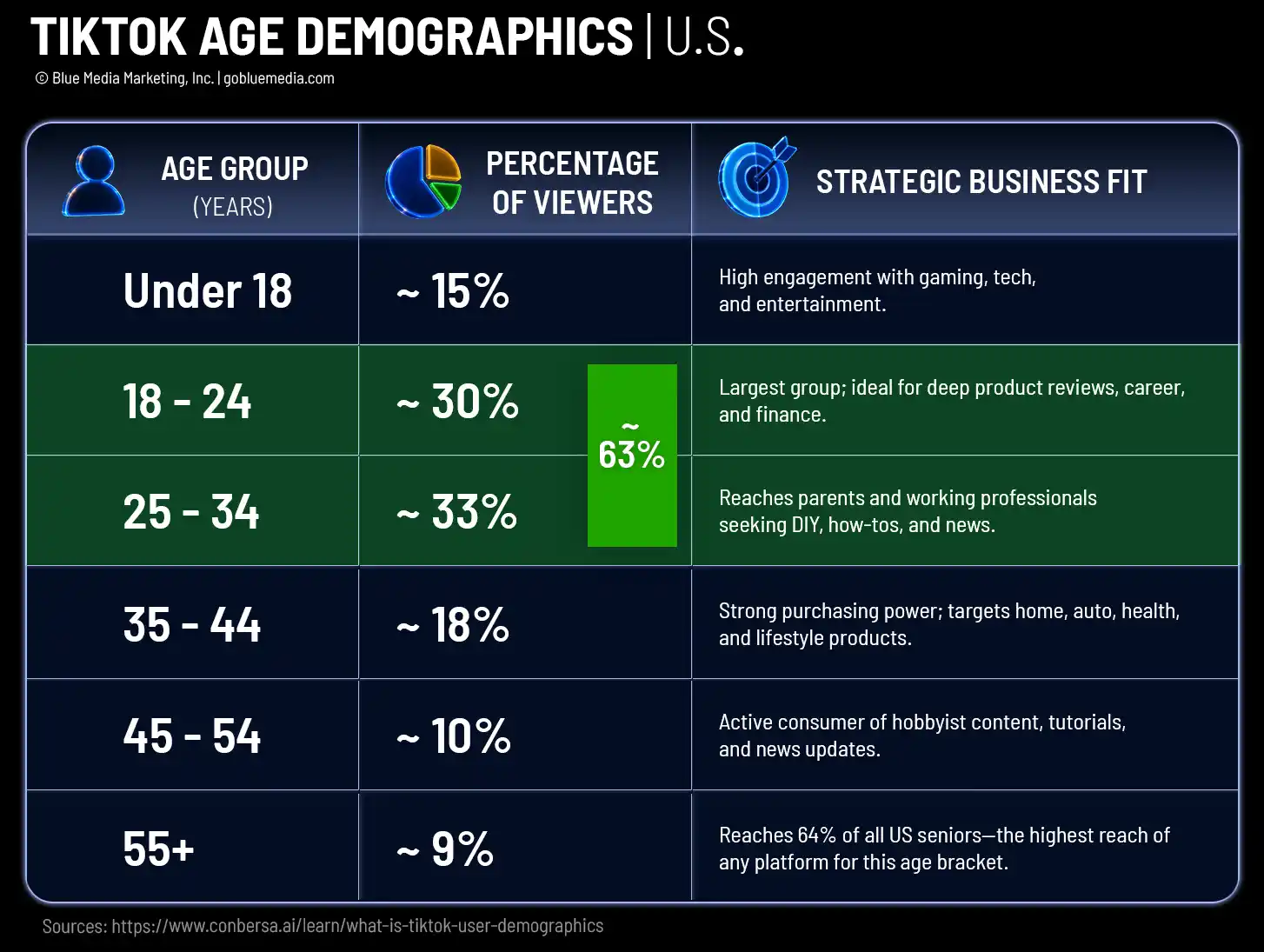
TikTok is clearly strongest among younger audiences, which explains why it has become such an important channel for brands trying to reach younger consumers.
The main takeaway is that TikTok’s audience is heavily concentrated among people under 35. This gives the platform a clear demographic advantage over Facebook and YouTube when the objective is to reach younger consumers. Businesses selling products or services that primarily appeal to younger people therefore find an audience on TikTok that is considerably harder to reach through more traditional Social Media Platforms.
However, TikTok’s audience declines considerably after age 35. As a result, the platform becomes less attractive as a primary marketing channel for businesses targeting older demographics.
The practical conclusion is straightforward: if the target customer is between 18 and 34, TikTok can be considered if only looked at it from a demographic angle.
For businesses targeting younger consumers, however, the decision is not based on demographics alone. TikTok also raises broader questions surrounding content quality, platform safety, misinformation, and brand suitability.
A recent scientific study, “A Social Media Quality Review of Popular Sinusitis Videos on TikTok,” found that up to 50% of the TikTok videos analyzed contained misleading information. Researchers at the University of Chicago have also pointed to the risks associated with false health claims and potentially harmful medical advice being distributed through TikTok.
This creates an important distinction between audience reach and platform quality. From a purely demographic standpoint, TikTok can be highly attractive for reaching younger consumers. From a brand-safety and ethical standpoint, however, businesses should also consider the environment in which their advertising and content appear.
TikTok has repeatedly faced criticism over misinformation, sensationalized content, rage bait, clickbait, questionable data practices, content moderation, and regulatory oversight. Unlike audience statistics, these issues cannot simply be reduced to reach or engagement numbers. Companies should therefore evaluate whether the platform’s content environment and reputation are compatible with their own values.
Reddit Demographics 2026
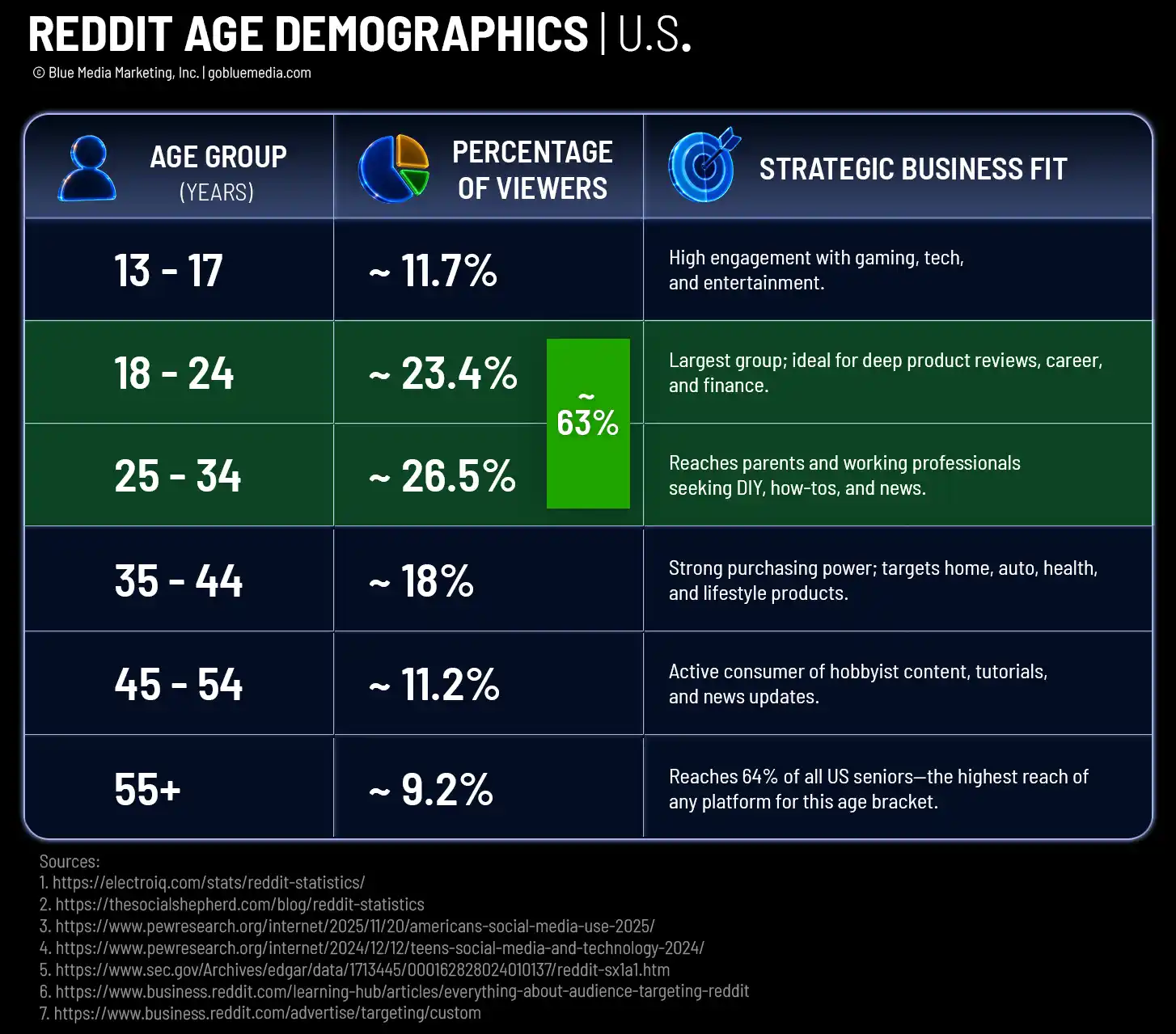
Reddit is different from almost every other platform in this comparison because it is not primarily built around following friends, influencers, or entertainment feeds. It is essentially a massive collection of forums organized around individual topics, questions, industries, products, hobbies, problems, and interests. Reddit itself now describes the platform as one of the internet’s largest open archives of continuously updated human conversations and experiences.
Its demographic strength is clearly among younger adults, particularly those between 18 and 34. But the more important business takeaway is what these users are doing on Reddit. People frequently arrive with a question or problem: Which product should I buy? Is this company legitimate? What is the best software for this purpose? How do I fix this? What was your experience with this service? That makes Reddit much closer to a research and knowledge platform than a traditional Social Media Feed.
The scale of the platform has now become enormous. There is no universally accepted ranking for the “world’s largest forum,” but Reddit is effectively the dominant forum-style discussion platform on the open web. According to Similarweb’s July 2026 estimates, Reddit is currently the 5th most visited website in the United States and 8th worldwide. Wikipedia, by comparison, ranks 12th worldwide. So by current estimated website traffic, Reddit is actually larger than Wikipedia.
This becomes even more important with the rise of AI. AI receives a good amount of its knowledge from Reddit. Thus, Reddit has become one of the most influential sources used by modern AI systems. OpenAI has an official partnership giving its systems access to Reddit’s Data API so that ChatGPT and other OpenAI products can better understand and surface Reddit content. Google has a similar agreement allowing access to Reddit’s data for Google products and model training.
Therefore, Reddit is now appearing extremely frequently as a source in AI-generated answers. A 2026 Peec AI analysis covering approximately 30 million cited sources found Reddit to be the single most-cited domain across the AI answers it analyzed, ahead of YouTube and LinkedIn. Separate Semrush research has also found Reddit consistently among the most frequently cited domains across ChatGPT, Google AI Mode, and Perplexity.
This changes the strategic value of Reddit considerably. A discussion about a company, product, service, or industry on Reddit may no longer influence only the people reading that particular thread. It can potentially become information that later appears in Google AI results, ChatGPT, Perplexity, and other AI-generated answers. For businesses concerned with SEO and AI visibility, Reddit has therefore become a platform that should not be ignored because it looks like a collection of discussion boards.
Businesses also have several ways to advertise directly on Reddit. Reddit offers traditional image and video ads, carousel ads, long-form Free-Form Ads, Conversation Ads that appear inside discussion threads, product advertising, sponsored AMAs (A sponsored AMA on Reddit is a paid, promoted “Ask Me Anything” session between a business or public figure and Reddit users), and premium takeover placements. Advertisers can target people according to the communities they participate in, their interests, specific keywords appearing in conversations, demographics, and custom audiences such as previous website visitors.
But paid advertising is only one side of Reddit. Businesses can also maintain an official presence, monitor discussions about their brands and products through Reddit Pro, participate in relevant communities where subreddit rules permit it, answer questions, and conduct AMAs. This requires a very different approach from Instagram or Facebook: obvious self-promotion is often poorly received, while genuinely useful participation can establish credibility within highly specialized communities. Reddit itself recommends using Reddit Pro to track conversations about a business, its products, competitors, and relevant topics before participating.
For businesses, that is the real takeaway from Reddit. Reddit has developed into one of the internet’s largest repositories of human questions, opinions, recommendations, reviews, and experiences. Those conversations influence purchasing decisions, rank prominently in Google, and are increasingly being incorporated into AI-generated answers. That gives Reddit a strategic importance far beyond what its age demographics alone would suggest.
Pinterest Demographics 2026
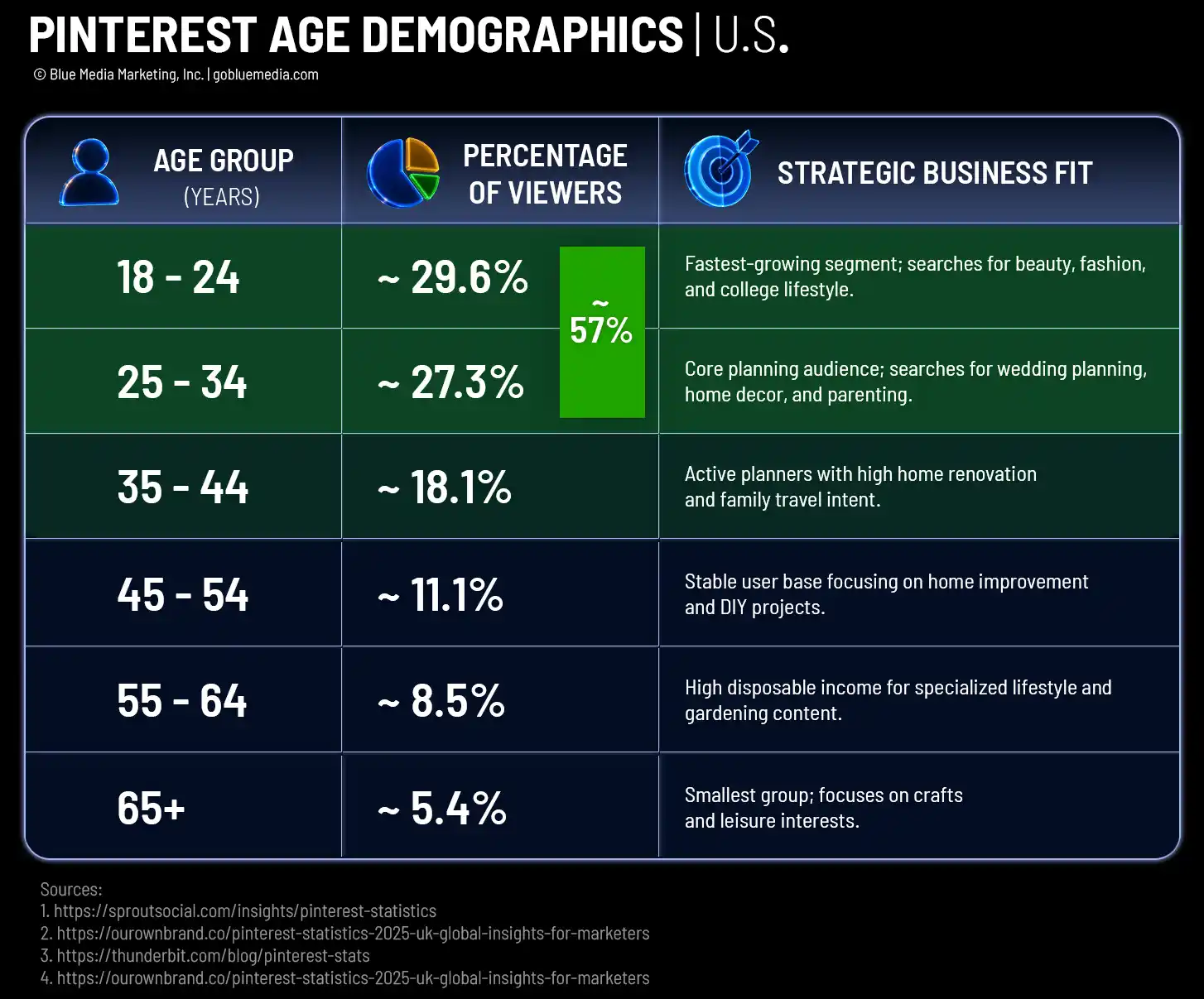
Pinterest occupies a very specific position among Social Platforms because people often use it less for social interaction and more for planning, inspiration, discovery, and future purchases. Users frequently arrive with an idea already in mind – planning a wedding, redesigning a room, choosing an outfit, organizing a trip, finding recipes, or researching a project.
That makes Pinterest particularly interesting for businesses because the platform can reach people before a purchasing decision has been made. Instead of simply interrupting users with advertising, businesses can place products, ideas, and services directly into the planning and discovery process.
Demographically, Pinterest is strongest among younger adults. More than half of the audience is between 18 and 34, making the platform particularly relevant for businesses targeting younger consumers who are entering important purchasing stages of their lives. This includes categories such as fashion, beauty, weddings, home decor, parenting, travel, food, and lifestyle products.
However, Pinterest should not be considered a platform only for young adults. The 35-44 audience remains substantial, and even users between 45 and 64 maintain a meaningful presence. This is particularly important for industries such as home improvement, interior design, gardening, DIY, travel, and other categories where consumers may spend considerable time researching and planning before making a purchase.
This is where Pinterest differs substantially from platforms such as TikTok or Instagram. TikTok is heavily driven by entertainment and immediate discovery, while Instagram revolves strongly around visual content and creators. Pinterest behaves much more like a visual search and planning engine. A user searching for “modern kitchen ideas,” “small backyard landscaping,” “wedding table decoration,” or “living room remodel” is expressing a much clearer interest than someone simply scrolling through an entertainment feed.
For businesses, this can create an important advantage. Pinterest content can become part of the customer’s research process long before the final purchase. A furniture company, remodeling contractor, wedding business, fashion retailer, travel company, or home decor brand can therefore reach potential customers while they are actively collecting ideas and deciding what they want.
Businesses can participate organically by publishing Pins that link directly to their websites, products, articles, guides, and landing pages. Pinterest also offers paid advertising through Promoted Pins and other visual ad formats, allowing businesses to target users according to interests, keywords, demographics, and behavior. This makes Pinterest particularly useful when a product or service can be communicated visually and when customers tend to research or plan before purchasing.
The main takeaway is therefore not simply that Pinterest has a relatively young audience. Its real strategic value comes from user intent. People frequently use Pinterest because they are planning something they may eventually spend money on. For the right business, that can make Pinterest much more commercially valuable than its overall audience size might initially suggest.
LinkedIn Demographics 2026
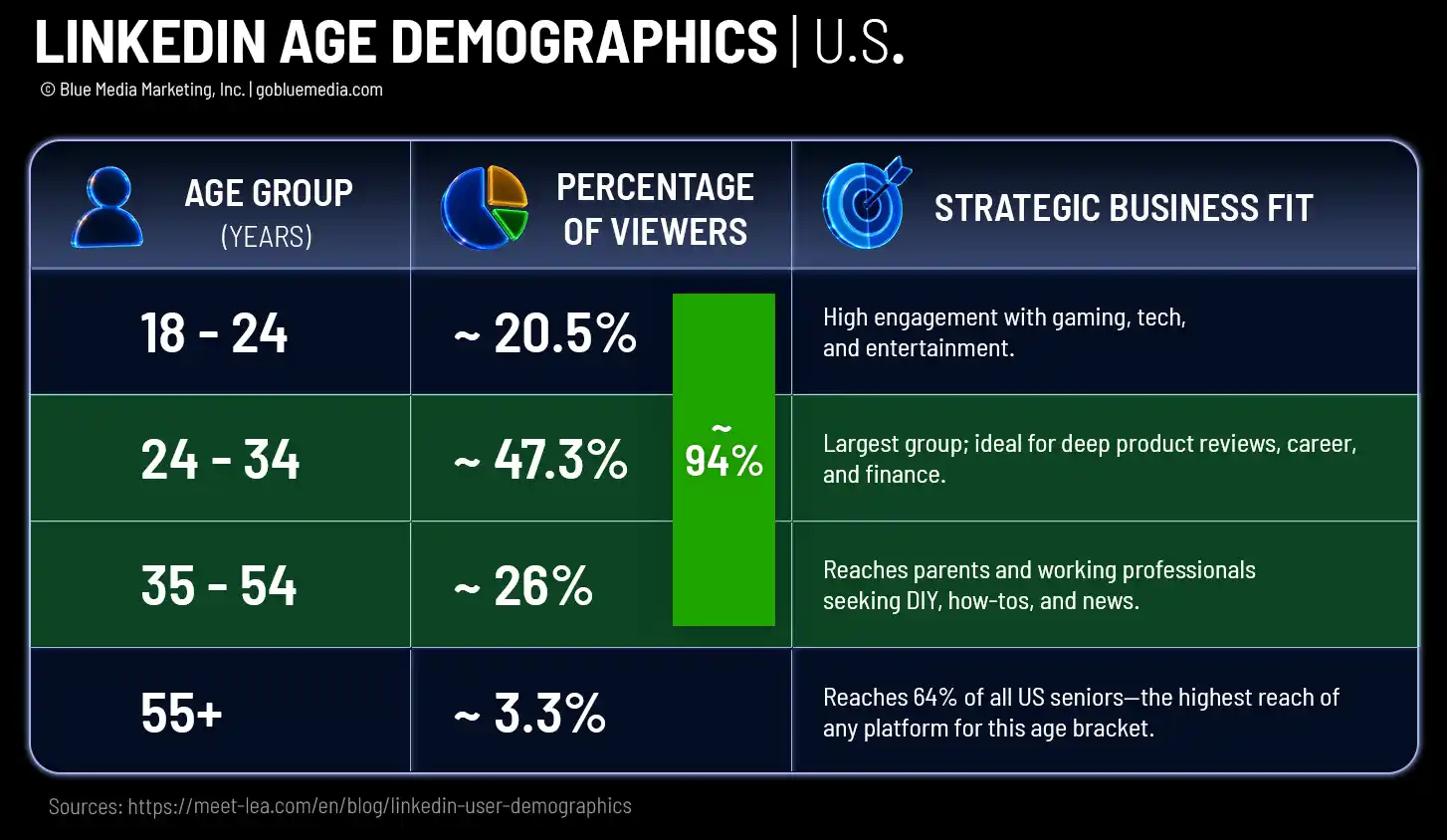
LinkedIn stands apart from the other Social Platforms in this comparison because it is not primarily built for entertainment, lifestyle browsing, or casual social interaction. Its core purpose is professional networking, career development, industry visibility, recruiting, and business communication. That alone changes how businesses should interpret its demographics.
The main takeaway from this chart is that LinkedIn is overwhelmingly an adult professional platform. Nearly the entire audience falls between the ages of 18 and 54, with the strongest concentration by far in the 24-34 range. In practical terms, this means LinkedIn is most valuable when a business wants to reach people in their working and career-building years rather than teenagers or retirees.
For businesses, that makes LinkedIn especially relevant for B2B marketing, recruiting, professional services, consulting, software, finance, education, coaching, corporate training, and any offering tied to career growth or business decision-making. The platform is less about impulse attention and more about professional relevance. People are often on LinkedIn because they want to build credibility, grow their careers, stay informed, evaluate opportunities, or connect with other professionals.
That is what makes LinkedIn strategically different from platforms such as Instagram, TikTok, or Facebook. On those platforms, the user may primarily be looking for entertainment, inspiration, or casual browsing. On LinkedIn, the user is much more likely to be in a business-oriented mindset. For many companies, that can make LinkedIn especially valuable even if its total audience is smaller than that of broader social platforms.
The relatively limited share of users over 55 also tells us something important. LinkedIn is not the strongest platform when the target audience is retired. But that does not reduce its value for business marketing. If the goal is to reach professionals, decision-makers, job candidates, partners, or people building their careers, LinkedIn remains one of the most concentrated and strategically aligned platforms available.
For businesses, the real takeaway is therefore not simply that LinkedIn has a large 24-34 audience. It is that LinkedIn reaches a highly career-oriented, professionally engaged adult audience. If a company needs visibility in a business context rather than an entertainment context, LinkedIn can be one of the most effective platforms in the mix.
Google Search Demographics 2026
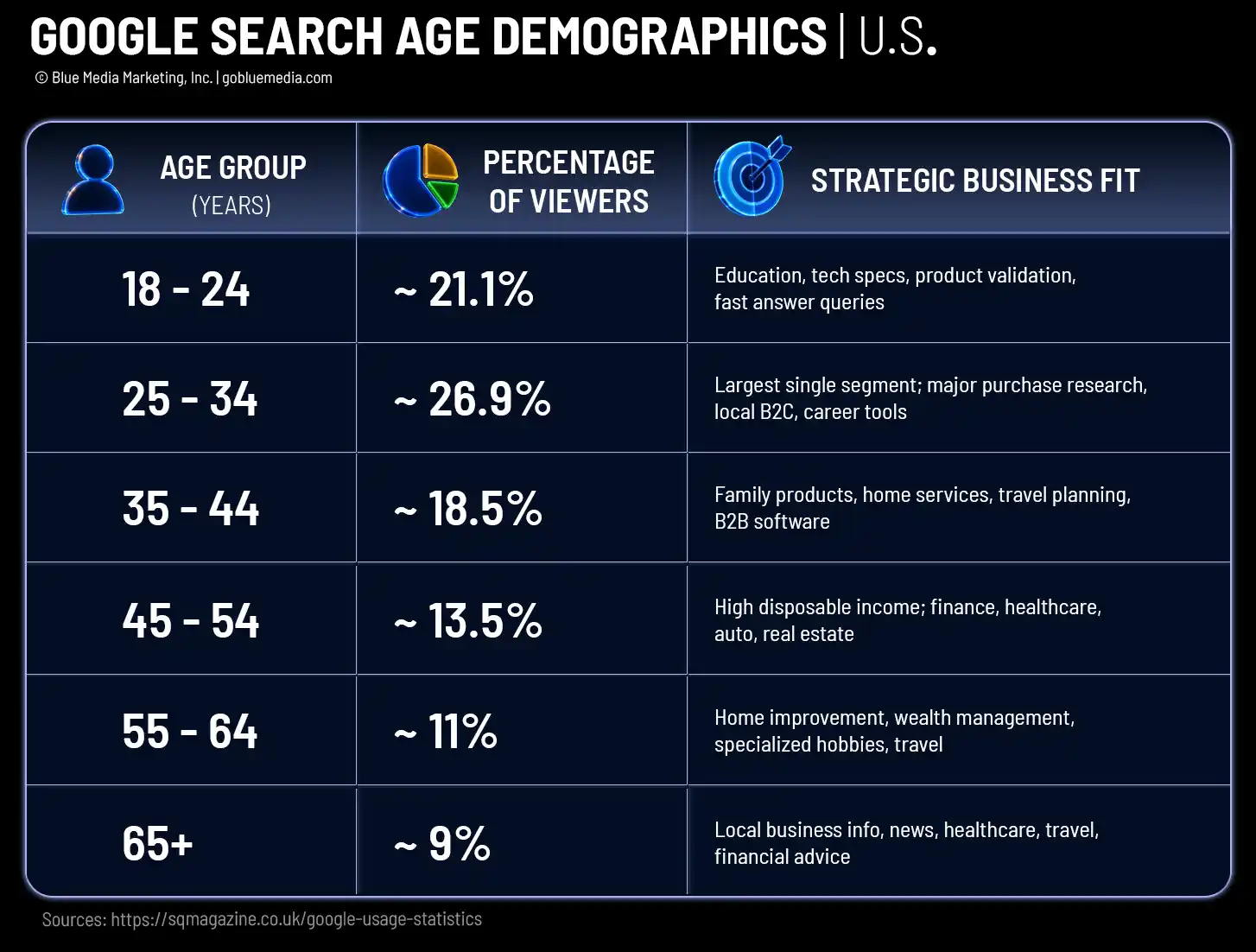
After looking at each platform individually, Google Search stands out for one important reason: its audience is not concentrated in one narrow demographic. The chart shows meaningful usage across every adult age group, from 18-year-olds to consumers over 65. Social Platforms, by comparison, often have much stronger demographic biases.
That broad reach is only part of Google’s advantage.
The more important difference is intent.
Someone scrolling through Instagram, TikTok, Facebook, or YouTube may be entertained, communicating with friends, following creators, or simply passing time. A person searching Google is actively asking for something. They may be looking for a contractor, comparing software, researching a medical procedure, finding an attorney, checking product reviews, evaluating a financial service, or trying to solve a specific problem.
That distinction is fundamental for businesses.
Google Search is primarily a demand-capture channel. The customer already has a need, question, or interest, and the purpose of SEO is to make the business visible at precisely that moment. This is one reason search remains so commercially important. Current research still identifies search engines as the leading source of brand discovery among online adults and the primary destination for researching potential purchases.
Google itself also remains overwhelmingly dominant within search. As of 2026, Statcounter estimates that Google accounts for approximately 86.6% of U.S. search-engine usage, and more than 93% of mobile search.
For many businesses, especially local services, professional services, healthcare, finance, B2B, home improvement, legal services, real estate, and other categories involving significant research or high-value purchasing decisions, that combination of reach and intent is extremely difficult to replace.
But this does not mean that every marketing dollar or every visibility effort should be placed into Google.
Google has one significant limitation: it is strongest when demand already exists. A person generally needs to know that a product, service, problem, or category exists before searching for it. Social media can reach that person earlier.
That is where platforms such as TikTok, Instagram, Facebook, YouTube, Reddit, Pinterest, and LinkedIn become valuable. They can introduce an idea before someone has decided to search for it. A consumer may discover a product through TikTok, see it again on Instagram, watch a detailed YouTube review, read opinions about it on Reddit, and only then search Google for the company, price, reviews, or alternatives.
The channels are therefore not necessarily competing for the same moment in the buying process.
- Social Media can create awareness and demand.
- Search can capture that demand once the person actively begins looking for a solution.
This is particularly important among younger consumers. Current research shows that social networks are the preferred online destination among users aged 16 to 44, while individual platforms such as Instagram remain disproportionately strong among younger adults.
Social Platforms also provide capabilities that Google Search cannot reproduce in exactly the same way. Businesses can build communities, work with creators, demonstrate products visually, generate conversations, distribute video, encourage user-generated content, retarget previous visitors, and repeatedly expose audiences to a brand before they are ready to buy.
There is also a risk-management argument.
Depending entirely on one source of customer acquisition creates concentration risk. Google changes its search algorithms, search-result layouts, advertising formats, and AI features continuously. A business that receives nearly all of its leads from organic Google traffic can therefore be exposed when rankings or search behavior change.
The same warning applies to Social Media. Building an entire business around Facebook, Instagram, TikTok, or any other individual platform is equally risky. These are all third-party ecosystems. Algorithms change, organic reach changes, advertising costs change, demographics shift, and platforms themselves rise and decline.
Diversification does not mean that every business needs to be active on every platform.
The demographic analysis throughout this article demonstrates exactly why. A business targeting retirees may find little strategic reason to devote significant resources to Instagram. A B2B company may find LinkedIn substantially more useful than Instagram. A remodeling company could benefit from Google, YouTube, Pinterest, and Facebook, while a fashion brand targeting younger consumers might place far greater emphasis on Instagram.
Google will often remain the center of that strategy because search combines enormous reach with something marketers rarely get elsewhere: an explicit statement of what the customer wants at that particular moment.
But Google does not own the entire customer journey.
A prudent digital strategy uses SEO to capture existing demand while selectively using the Social Platforms that actually match the target audience, buying behavior, industry, and type of product or service being marketed.
For some businesses, that may mean Google plus LinkedIn. For others, Google plus Instagram and Pinterest. Others may benefit from YouTube, Reddit, Pinterest, or Facebook.
The answer should come from the customer, not from the popularity of the platform.
That is ultimately the central conclusion of this analysis: Google Search remains the strongest general-purpose visibility channel for many businesses, but the strongest marketing strategy is rarely one that depends exclusively on Google. Search and Social Media perform different functions. The goal is not to choose a winner between them, but to determine which combination reaches the right customer at the right stages of the decision-making process.