

 by
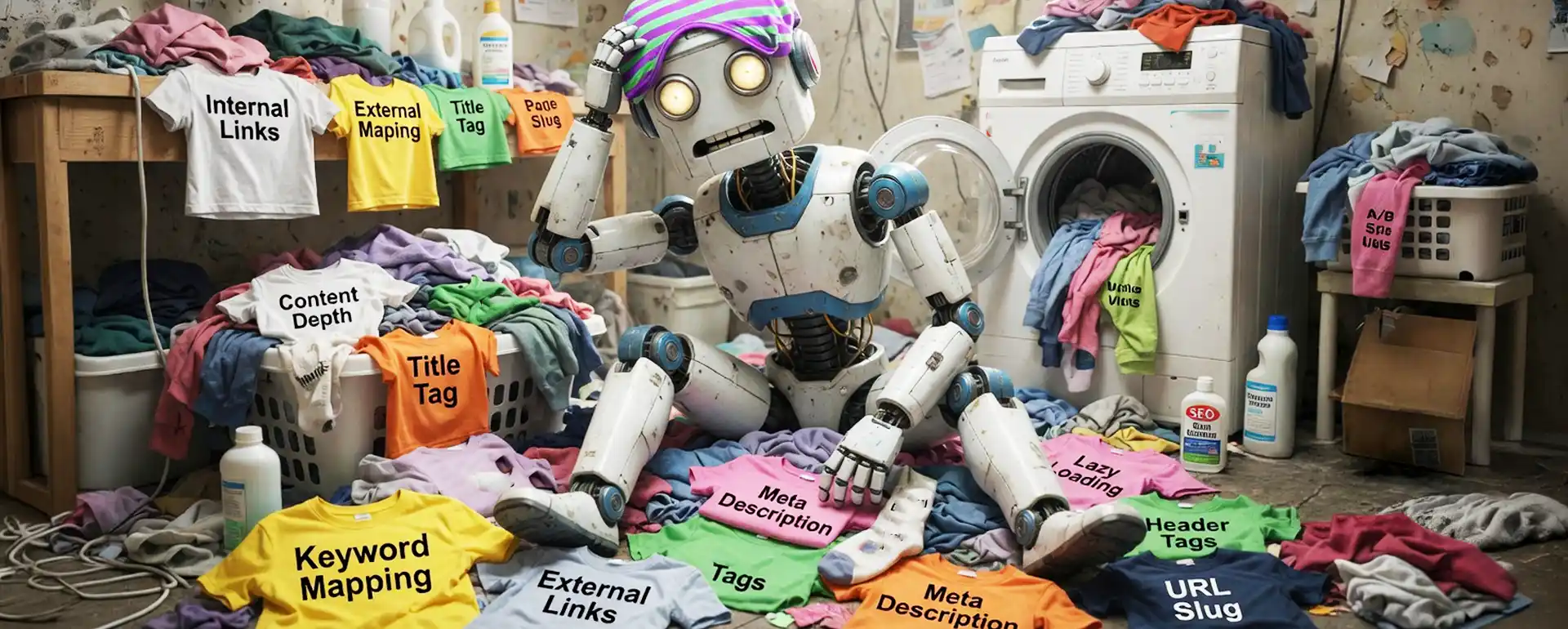
by A pattern has been appearing sometimes in conversations with clients. Some might believe that AI has replaced the need for SEO experts. The reasoning seems straightforward.
AI systems have access to vast amounts of knowledge, can generate answers instantly, and can outline what looks like a complete SEO strategy within seconds. For many business owners, this creates the impression that they can manage SEO themselves without external expertise.
I saw this clearly in a recent conversation with a prospective client. She explained that she had decided not to work with an SEO specialist. Instead, she relied entirely on AI tools. She would ask what needed to be improved on her website and then implement the recommendations step by step.
At first glance, this approach sounds reasonable for her. The tools are accessible, the answers are structured, and the process feels efficient.
Out of curiosity, I checked her rankings using standard SEO tools.
There had been no meaningful progress.
Several months later, nothing had changed.
Her website still had low visibility.
Traffic had not increased.
The expected business results had not materialized.
The issue was not a lack of knowledge. AI had provided her with accurate SEO advice. The problem was that she did not know how to retrieve the existing knowledge from the AI machine, and how to use that knowledge correctly.
The Misconception: Access to Knowledge Equals Capability
AI has dramatically lowered the barrier to accessing SEO knowledge. Tasks that once required years of experience can now be initiated with a simple prompt. You can ask how to structure a page, how to choose keywords, or how to improve technical performance, and you will receive a clear answer immediately.
This creates a fundamental misunderstanding. People begin to assume that having access to knowledge is the same as being able to apply it effectively.
In SEO, this assumption does not hold. Success is not determined by how many correct actions are taken. It is determined by whether the right actions are taken, in the right order, within a specific context.
To understand this, consider two websites operating in the same niche. Both follow standard SEO advice. They use keywords correctly, publish content regularly, and ensure their pages load quickly. One of them ranks on the first page. The other remains invisible.
The difference is not effort or even correctness. The difference is relevance and prioritization.
The successful site identified an opportunity that matched its current position. For example, it might have targeted a keyword with lower competition or built authority in a narrow topic before expanding.
The unsuccessful site applied general best practices without considering whether those actions addressed the competition and the existing market.
In other words, knowledge was present in both cases.
Only one applied it in a way that matched reality.
SEO as a Diagnostic Discipline
SEO should be understood as a diagnostic discipline rather than a checklist of improvements.
Every website operates within a competitive environment. Rankings are not determined in isolation. They are determined relative to other pages competing for the same queries. This means that performance depends on how a site compares to its competitors, not simply on how well it follows general best practices.
An experienced SEO expert approaches a project by diagnosing what is limiting visibility. This involves several layers of analysis. They examine whether the content matches user intent. For example, if users searching for a topic expect a comparison or a guide, a simple product page may not satisfy that expectation.
SEO experts analyze the strength of competing pages. This includes looking at domain authority, and the overall depth of content in the topic area. They also assess technical factors. Sometimes a page fails to rank not because of content quality, but because search engines cannot properly crawl or index it. Only after identifying the main constraint does it make sense to decide what to do next. Without this step, optimization efforts often focus on visible improvements that do not affect rankings.
Where AI Falls Short in Practice
AI can reproduce the language of SEO with high accuracy. It can suggest improvements, explain strategies, and generate content structures that look professional and complete. However, it does not independently evaluate whether these suggestions are appropriate in a specific market. Consider again the example of a product page that receives no organic traffic. An AI system will typically recommend improving the page itself. It may suggest adding more detailed descriptions, improving layout, including reviews, or enhancing trust signals. These changes can improve user experience. They may even increase conversion rates if traffic already exists. But they do not address the question of whether the page can rank at all. SEO strategy requires interpretation. It requires deciding that the initial direction is flawed. AI does not make that decision on its own.The Role of SEO Expertise in an AI-Driven Environment
The rise of AI does not eliminate the need for expertise. It changes where that expertise is applied.
The value of an SEO professional is no longer in memorizing best practices or performing routine tasks manually. Those tasks can be supported or accelerated by AI. The real value lies in interpretation and decision-making, and asking the right question.
An expert understands how to evaluate a situation, identify the main constraint, and decide where to focus effort. They know when to ignore certain recommendations and when to pursue others.
In practice, SEO professionals already use AI as well. They use it to generate content drafts, analyze large datasets, and explore keyword variations. However, they do not rely on it to define the SEO strategy.
For example, an expert might use AI to generate multiple content ideas. Instead of executing all of them, they will select only those that align with the site’s current authority and competitive landscape. This selection process is what determines success.
AI as an Amplifier, Not a Substitute
AI has not introduced a completely new model for SEO. It has made possible to retrieve SEO knowledge from a huge database using prompts. That database existed before but wasn’t easily retrievable before.
AI makes information easier to access. It allows us to understand it faster. At the same time, it increases the risk of producing generic strategies that do not stand out. It mostly simplifies things to make the user happy.
The core problem in SEO has always been the same: when everyone follows the same advice, the outcome becomes indistinguishable. Most websites improve content length, add keywords, and optimize structure in similar ways because they rely on widely shared best practices. On paper, these actions are correct. In reality, they lead to uniform results. Instead of becoming more competitive, websites become more alike.
This pattern has existed for years, especially with offshore SEO teams. Especially small business owners sometimes outsource SEO to low-cost providers who follow standardized processes. The work is efficient and consistent, but also predictable. The same templates are applied, the same checklists are followed, and the same types of changes are implemented across different websites.
I have seen this repeatedly. Different companies, different industries, but the output looks almost identical. In the end, Google does not see anything distinctive. It sees another website that follows standard SEO patterns without offering a clear reason to rank higher than others.
The same dynamic is now emerging with AI. When businesses rely on AI-generated advice without a clear strategy, they tend to produce the same type of content and optimizations as everyone else. The result is technically correct, but strategically weak. Nothing stands out, and without differentiation, there is no competitive advantage.
What creates an advantage is not the ability to follow general advice, but the ability to identify opportunities that others overlook. This often involves making trade-offs, focusing on specific areas, and adapting to constraints.
SEO requires judgment, not a process.
Future of SEO With AI
I won’t make the assumption that AI will never be able to accomplish what an SEO expert is capable of. I’m just saying that it’s not possible as of 2026, yet.
So let’s have a look at a possible future.
To make the human role obsolete, the AI game has to change. The defining capability of a future system would not be better answers, but independent judgment about the question itself. Such a system would not begin with standardized recommendations. It would begin with rejection, revision, or confirmation of the premise. It would analyze the competitive landscape, assess the structural position of a website, and determine whether the intended goal is feasible. If it is not, it would redirect effort toward a different objective without waiting for instruction.
This would transforms AI from a tool into a decision-making system. It requires the integration of several layers that do not currently operate together in a unified way. The system would need to maintain a live model of the environment in which a website operates. It would need to interpret search results not as static outputs, but as signals of competition, authority, and intent. It would need to distinguish between actions that improve quality and actions that change outcomes, understanding that these are not always the same. Most importantly, it would need to make trade-offs. It would need to ignore correct but irrelevant recommendations in favor of fewer actions with higher leverage.
For AI to be truly effective in SEO, it would need to go beyond being helpful and responsive. It would need to challenge the user.
At times, that means being uncomfortable to work with, questioning assumptions, and pushing back against decisions that seem logical on the surface but are strategically flawed.
This is a role SEO experts regularly take on.
They do not simply execute requests. They question direction, point out risks, and redirect focus when necessary, even if that creates friction. That tension is not a weakness of the relationship. It is precisely what makes it valuable.
Progress in SEO often comes from confronting incorrect assumptions rather than reinforcing them. A system that only agrees and responds smoothly can produce answers, but it cannot guide decisions. The effectiveness of an SEO expert lies in their willingness to challenge, and in the trust that allows that challenge to happen.