


 by
by Recently, a long-term client approached us with a profound crisis of faith — one for whom we have been providing SEO for more than 15 years.
Watching his teenage children spend hours swiping endlessly through TikTok Reels and Instagram feeds, the CEO came to a sudden realization:
“No one uses Search Engines anymore. Everyone is on Social Media. Should we abandon SEO entirely and focus all our resources on social platforms?“
It is an understandable panic. When you watch the next generation consume content at hyper-speed, traditional Google search results can look almost antique by comparison. However, confusing teenager’s entertainment habits with customer’s purchasing behavior is one of the most dangerous traps in digital marketing — especially when your business sales high priced products, not $15 phone cases.
Although this client is a home manufacturer, the case shows a broader question for any brand selling high-ticket products: Should it invest in Social Media or SEO, and how does that choice affect long-term growth?
Let’s examine this question through data, consumer psychology, and market realities to determine whether SEO is indeed approaching extinction.
The Teenager Fallacy: Will “Swiping” Kill SEO in the Long Run?
To address my client’s immediate concern directly, the firsst thing that came to my though is this:
Teenagers are not buying houses.
The first question, regardless of what you sell, is who your target audience actually is. You should understand its demographic profile, and your SEO agency should know this as well before launching an SEO campaign. Most business owners already have a strong sense of their clientele and age. However, it’s always a good idea to let research validate that knowledge.
As for the house manufacturer I am using as an example here, let’s look at this data: According to the latest National Association of Realtors (NAR) Profile of Home Buyers and Sellers report, the median age of a first-time home buyer in the United States is 38 years old, while repeat home buyers have a median age of 61 years old. The decision-makers with the financial backing to construct or purchase a home are currently Gen X and Millennials generations that rely heavily on web searches for high-stakes research. Also means, all buyers conduct online research before buying a home. And the average duration of the home search process in the United States in 10 weeks.
Will Gen Z Inherit Their Swiping Behavior into Adulthood?
The deeper question is what happens when those teenagers reach 38. Will they retain their Social-Media-first habits, rendering SEO obsolete?
Data summarized by ResearchAndMarkets’ Gen Z Social Search Habits Report and eMarketer shows that roughly 46% of Gen Z users prefer social platforms over traditional Search Engines for everyday brand discovery. They use short video feeds as visual search tools for fashion, food, quick tutorials, and lifestyle choices.
However, while social platforms excel at casual discovery, they collapse under the weight of high-consideration purchases.
When a 20-year-old TikTok user turns 38 and needs to make a $800,000 home purchase, their research behavior inevitably shifts. High-stakes decisions demand deep research: architectural floor plans, local zoning laws, building material energy ratings, structural warranties, and municipal permit requirements. A 15-second vertical video cannot deliver detailed engineering specifications or complex cost breakdowns.
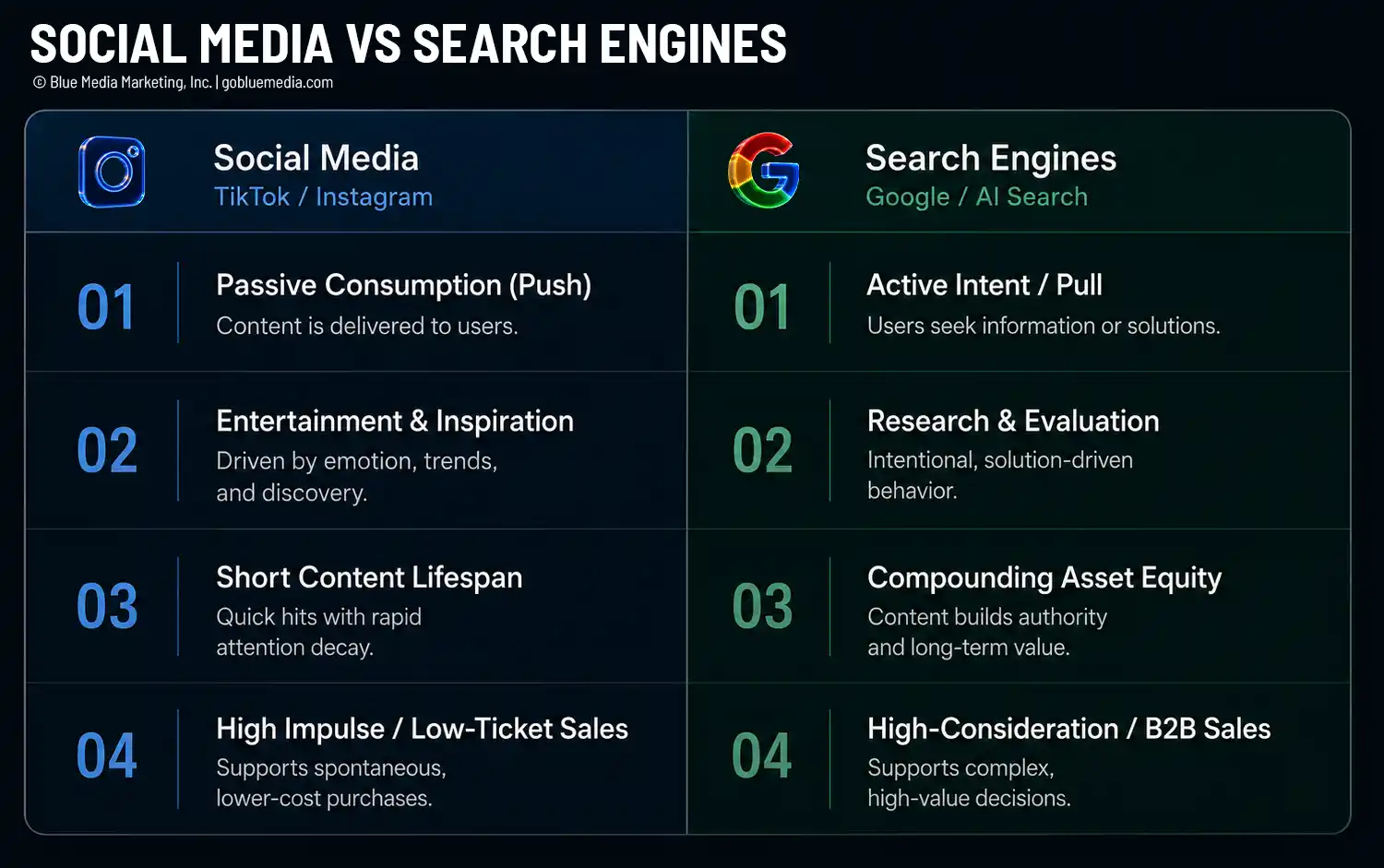
The nature of the intent dictates the tool. Social Media is an entertainment and passive discovery tool: Search Engines on the other hand are intent-driven research execution platforms.
Social Media Usage vs. Search Behavior: Is Google Search Really Declining?
Contrary to popular belief, Social Media’s rise has not caused Google’s collapse. While Social Search is growing for top-of-funnel brand discovery, Google still handles over 8.5 billion searches per day, maintaining dominant market share globally.
In this example, imagine a potential buyer looking for a prefabricated house builder:
On TikTok or Instagram for example, they might encounter a beautiful 15-second tour of a modern home set to trending audio. It builds brand awareness — which is considered top of funnel — were brand awareness for these young folks is being created. But how does the user compare local energy codes, check real-time pricing, review client testimonials, or download technical blueprints? They can’t.
On Google, the user actively types things like: “best energy-efficient prefab house builders near me” or “cost per square foot for modern timber frame homes.”
The search user possesses High Commercial Intent. They are actively looking to spend money and evaluate concrete options.
Key Takeaway here is that Social Media is where brand consideration begins: Search Engines and structured websites are where high-ticket buying decisions are validated and executed.
How AI Search is Securing Google’s Future
Google isn’t sitting passively while social feeds absorb attention. Through Google AI Overviews and multimodal AI features, Google is rapidly evolving.
By integrating generative AI directly into search results, Google synthesizes complex data, combining video clips, technical documentation, reviews, and interactive widgets into a single context-rich view. Instead of losing to Social Feeds, Google is retaining its ultimate advantage: Intent Matching.
The Nature and High Cost of Social Media
Many business owners might view Social Media as an additional channel to SEO. However they often miss the most important challenge: building an Social Media Presence is one of the most volatile, labor-intensive, and uncertain endeavors a company can undertake.
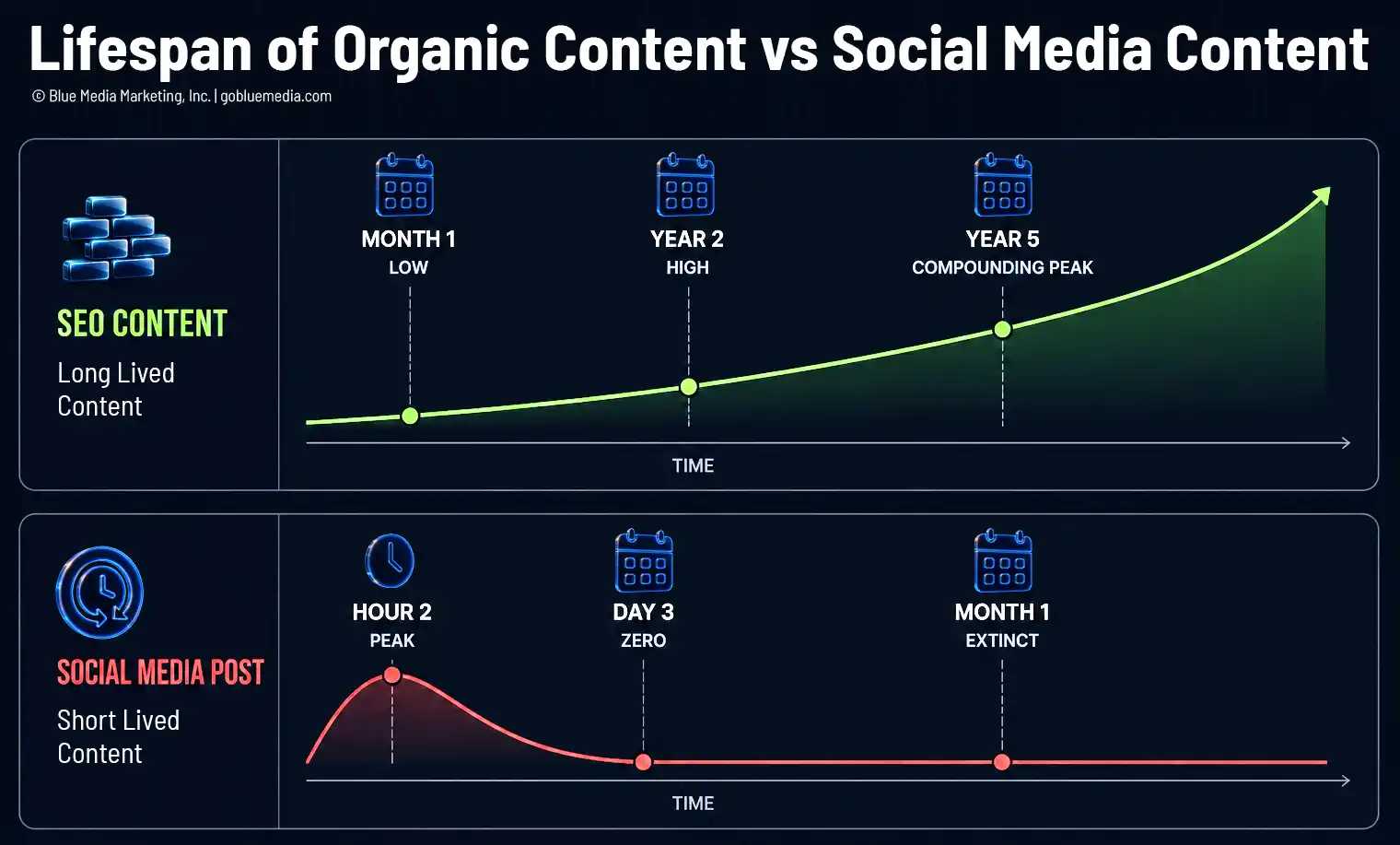
Social Media content operates on a rapid decay cycle. A post published on Instagram or TikTok has an effective lifespan of 24 to 48 hours before the algorithm buries it in pursuit of fresh content.
In contrast, a high-quality, SEO-optimized guide or technical article on your website is a compounding digital asset. An article written about “Understanding Home Foundation Costs” can continue to drive qualified, high-intent traffic to a business for years without costing an extra cent in advertising.
Why Community Is the Foundation of Social Media
Community is one of the most important factors on any Social Media Platform.
A community consists of people who repeatedly return to a creator’s content. They follow or subscribe, watch new posts, interact with them, and gradually build a relationship with the creator.
This sometimes raises an important question for many companies — I have been asked that question many times in business talks:
Why do Social Media Platforms care about followers and subscribers? Why are views not enough?
Here is the answer: Subscribers do more than increase follower numbers. It gives the platform the data it needs to decide whether new content deserves wider distribution. Because a view tells the Social Media Platform that someone saw the content. A returning audience helps the platform evaluate whether the content is actually valuable. When a creator publishes a new post, the Social Media Platform often begins by showing it to a limited group of people, including existing followers and users with similar interests. It then measures how they respond:
- Do they stop scrolling?
- How long do they watch?
- Do they finish the video?
- Do they like, comment, save, or share it?
- Do they immediately scroll away?
- At what point do they lose interest?
These signals help the algorithm determine whether the content should be distributed to a larger audience. In that sense, a creator’s community acts as an initial testing group. If the existing audience responds positively, the platform gains confidence that other users may also find the content interesting. If the response is weak, distribution may stop before the post reaches many new people.
This is especially important because Social Media is primarily driven by recommendation feeds. Users often do not search for a specific topic. They scroll or swipe through content selected for them by an algorithm. The platform must therefore predict what each person is likely to watch before presenting it. That prediction depends heavily on behavioral data.
This is why Social Media platforms encourage creators to gain followers, build communities, and generate continuous engagement. The community does not merely support the creator. More important, it supplies the algorithm with the early performance signals it needs to evaluate and distribute each new post.
Why SEO Works Differently
Search Engines operate through a different discovery model.
On Google, people usually begin with a specific question, problem, product, or service. They enter a search query, and the Search Engine attempts to identify the pages most relevant to that query. A website does not need an established follower community before its content can be discovered. Search demand already provides a potential audience. If people are searching for a topic and a page is considered relevant, Google can begin showing it to those users.
Google then evaluates numerous signals to determine whether the page deserves to maintain or improve its position. These may include relevance, content quality, authority, usability, and how well the page appears to satisfy the searcher’s intent.
This creates a fundamental difference:
- Social Media Content usually needs an existing or carefully identified audience to generate the initial data required for broader distribution.
- SEO Content can receive its initial audience directly from people already searching for the subject.
That’s why keyword demand still matters with SEO. A strong article targeting a topic that almost nobody searches for may receive very little traffic. A page targeting a high-demand topic may have a much larger opportunity, but it will also face stronger competition. Even when a page initially ranks well, it may later decline if Search Engines determine that competing pages satisfy users more effectively.
That is why community is essential for Social Media growth but not required for SEO. It also explains why even heavily trafficked blog posts often receive few comments. A blog can attract thousands of visitors, generate leads, and become a major source of business without ever developing an active community. Search visitors usually arrive because they need an answer, consume the information, and leave. They may never return, comment, or interact with other readers. In SEO, success is measured by visibility, qualified traffic, and conversions, not by the strength of the community surrounding the content.
Social Media depends on followers, engagement, and recommendation signals to create demand and distribute content. Search Engines connect existing demand with content designed to answer it.
In simple terms:
- Social Media requires creators to build an audience that helps the algorithm evaluate their content.
- SEO allows businesses to reach an audience that is already searching.
Why Most Products Struggle to Build a Social Media Community
Social Media communities are usually built around influencers, entertainers, experts, recognizable personalities, or shared interests. This leads to a more fundamental question:
How do you build a loyal community around a commercial product?
This is one of the most difficult challenges in brand marketing.
People rarely form meaningful relationships with ordinary products simply because a company publishes content about them.
The brands that succeed usually offer something beyond the product itself: a hobby, identity, lifestyle, culture, competition, or shared experience.
For example: Pokémon brings people together through collecting, trading, and fan culture. LEGO turns customers into participants by allowing enthusiasts to share creations and vote on ideas that may become official products. Harley-Davidson connects ownership to a broader riding identity supported by clubs and local chapters. In each case, the community is not built around purchasing a product. It is built around what people love, inspire, achieve, or experience through that product.
Most commercial products do not naturally provide these conditions. A home manufacturer, for example, sells an expensive product that most customers purchase only once or a few times in their lives. Buyers may care deeply during the research and construction process, but that does not mean they want to follow the manufacturer every day, interact with other customers, or regularly consume branded Social Media Content.
To build a genuine community in this example of a house manufacturer, the company would need to become more than a manufacturer. It would have to create an ongoing destination for architecture, interior design, construction, homeownership, energy efficiency, and lifestyle content. That is possible, but it requires continuous publishing, recognizable personalities, strong creative execution, and a long-term investment more comparable to operating a media brand than maintaining a conventional company profile.
This is why successful product communities are so rare. The product alone is usually not enough. The brand must give people a compelling reason to return even when they are not preparing to buy.
Why Most Content Creators Never Succeed
Even then, the odds of turning Socia Media Posts into a sustainable content are razor-thin. Publishing videos is easy. Building an audience that returns consistently, trusts the creator and generates enough commercial value to attract recurring advertisers is not. Most brands never make that transition. Sometimes a post may produce a temporary spike in attention and even go viral, but that alone does not create value.
The imbalance remains extreme even among creators who have already advanced far enough to secure paid brand campaigns. CreatorIQ found that the median creator in its 2025 payment data earned only about $3,000, while the top 10% captured 62% of all payments. The top 1% alone received 21%. These figures do not include the much larger population that posts content but never receives a payment at all. An estimated 0.04% of content creators worldwide attract enough attention to be considered influential.
The remaining 99.96% continue publishing, often daily, in the hope of eventually breaking through, occasionally going viral with one or two posts in their Social Media Lifetime. What they fail to build is a reliable audience that returns consistently. The dream is to reach the level of successful creators, where nearly every new post attracts significant attention. That possibility motivates hundreds of millions of people to keep trying.
Brands are caught in the same race. Local businesses, small companies, and global corporations all compete for attention through Social Media. Most invest time and resources without ever building meaningful reach and fame. Only a small fraction succeed in turning content into a dependable audience and a sustainable source of business.
Some businesses are naturally suited to social media attention. Trendy restaurants, bars, sports clubs, fitness brands, vacation spots, and companies built around hobbies or entertainment can benefit greatly from visual, shareable content. Visiting a new city may readily choose a restaurant recommended on TikTok is very likely and common, The same behavior rarely applies to high-stakes decisions. People are unlikely to choose an investment advisor, wedding planner, education, senior care provider, mental health treatment program, law firm, or RV simply because they saw an Instagram Reel. These decisions involve substantial cost, risk, trust, and long-term consequences. Customers typically conduct extensive research, compare providers, review credentials, and actively search for reliable information before making a commitment.
Competition is also increasing much faster than the available money. In 2025, the number of creators participating in campaigns through CreatorIQ grew by 183%. More people are entering the market, but the financial opportunity is not expanding nearly fast enough to support them.
Success therefore requires much more than producing good content. A creator must repeatedly earn algorithmic distribution, capture and retain attention, inspire an audience, and above all: entertain! The highly visible success stories are real, but they are exceptions.
What we see online is almost exclusively the small fraction of creators who have succeeded. The other 99.96% are largely invisible. This creates a powerful selection bias. Audiences see the winners everywhere while rarely encountering those who failed to gain traction, producing a distorted view of the market. As a result, Social Media success appears far more common, predictable, and attainable than it actually is. This is known as the Social Media Selection Bias.
Paid Ads, Organic Models, and the “Landing Page Only” Trap
If building an audience on Social Media is already difficult, an obvious question follows:
Why not abandon SEO, invest in Social Media Ads, and direct that traffic to dedicated Landing Pages?
To a business owner, this seems like the ultimate shortcut. You bypass the months or even years it takes to rank organically on Google, control the messaging completely on a focused Landing Page, and pay only for active clicks.
For a $20 t-shirt or a $50 gym membership, this strategy works. But for a high-consideration, high-ticket business relying solely on Social Ads and Landing Pages creates fatal vulnerabilities.
High-ticket buyers are inherently skeptical. When a prospect sees a Social Media Ad for a home builder and clicks through to a polished Landing Page, their instinct is not immediate conversion: it is verification.
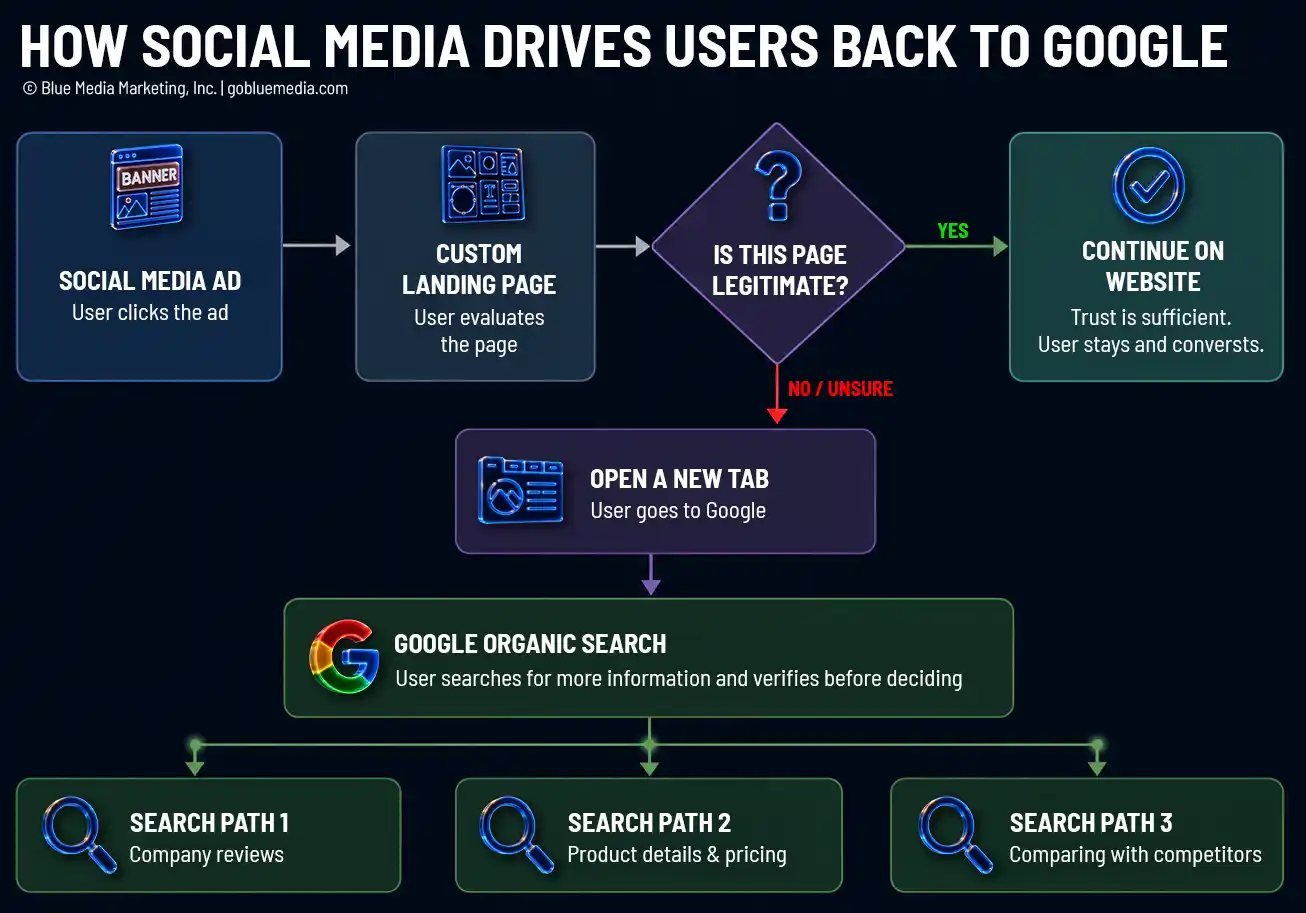
When that potential buyer leaves your Landing Page to research you on Google, what do they find? If you have strong SEO: They find a deep ecosystem of organic search results: your main domain ranking #1, positive third-party reviews, technical blog posts explaining your construction process, local press, and project galleries. Trust is established, and they return to convert.
If you abandoned SEO: They find an empty organic footprint, sparse search results, or worse: your competitors occupying all the organic search real estate for your industry’s top keywords. The buyer assumes you are an unverified operation, and the lead dies.
Social Ads generate curiosity — yes — but organic search presence provides credibility. A Landing Page alone cannot validate itself. Relying exclusively on Social Media Ads and Landing Pages therefore turns your marketing into a rented utility.
Paid Social vs Organic Social vs SEO
When you abandon SEO, your Customer Acquisition Cost (CAC) is capped by ad platforms. The moment ad costs (CPM/CPC) spike on Meta or TikTok, or when an algorithm change lowers your ad performance, your profit margins vanish.
You then also build zero equity. Every dollar spent on Social Ads is consumed immediately. SEO, by contrast, is like buying property: an article or Landing Page optimized for “custom timber frame builder in Ohio” generates free, high-intent traffic for 5 to 10 years without ongoing ad spending.
Also consider the the depth gap: A Landing Page can’t answer complex questions. As for my example with the house manufacturer: A home purchase involves long buyer journey. During this time, a prospect will have dozens of hyper-specific technical questions:
- What is the cost difference between slab and basement foundations?
- How long does municipal building permit approval take?
- What R-value insulation is required for modern prefabricated homes?
A single Social Media Landing Page cannot answer these questions without becoming an unreadable, cluttered mess.
If you abandon SEO, you give up the ability to capture prospective buyers during their deep research phase. A robust SEO strategy creates a network of content addressing every long-tail search query a buyer has. Each article acts as a organic magnet that pulls buyers into your brand ecosystem naturally, long before they are ready to talk to a salesperson.
Paid social advertising, organic social media, and SEO are often grouped together as digital marketing channels, but they operate according to fundamentally different economic models. The comparison below shows how each strategy differs:
Paid Social Ads
- Renting traffic from Meta/TikTok
- Turn off budget = 0 Leads
- CAC escalates as ad costs rise
- Vulnerable to algorithm changes
Organic Social Media Channel
- Building an audience / community
- Requires continuous engaging and entertaining content production
- Organic reach depends on platform algorithms
- Builds brand awareness, but leads remain unpredictable
Organic SEO Content Engine
- Owning digital real estate
- Compounding organic leads forever
- Zero cost-per-click
- Defensible moat against rivals
Why Organic Search and Social Ads Must Coexist
Google’s business model depends on maintaining a strict separation between Paid Ads and Organic Value. Google states that advertising spend can’t influence organic rankings. Users can buy sponsored visibility, but they can’t buy organic authority: it must be earned. Current clickstream research from Similarweb and SparkToro also shows that paid links still capture only a small minority of Google search clicks.
Both, Social Media Ads and Social Media Feeds create initial interest. For simple, low-cost purchases such as apps, shopping or subscriptions, that interest may be enough to generate a direct sale.
For expensive or complex purchases, however, an ad rarely closes the sale by itself. After becoming interested, the buyer searches for more information, compares options, evaluates credibility, and looks for reassurance. Organic SEO supports this research phase by educating the buyer, validating the company, and building authority. That process can ultimately lead to a high-value purchase.
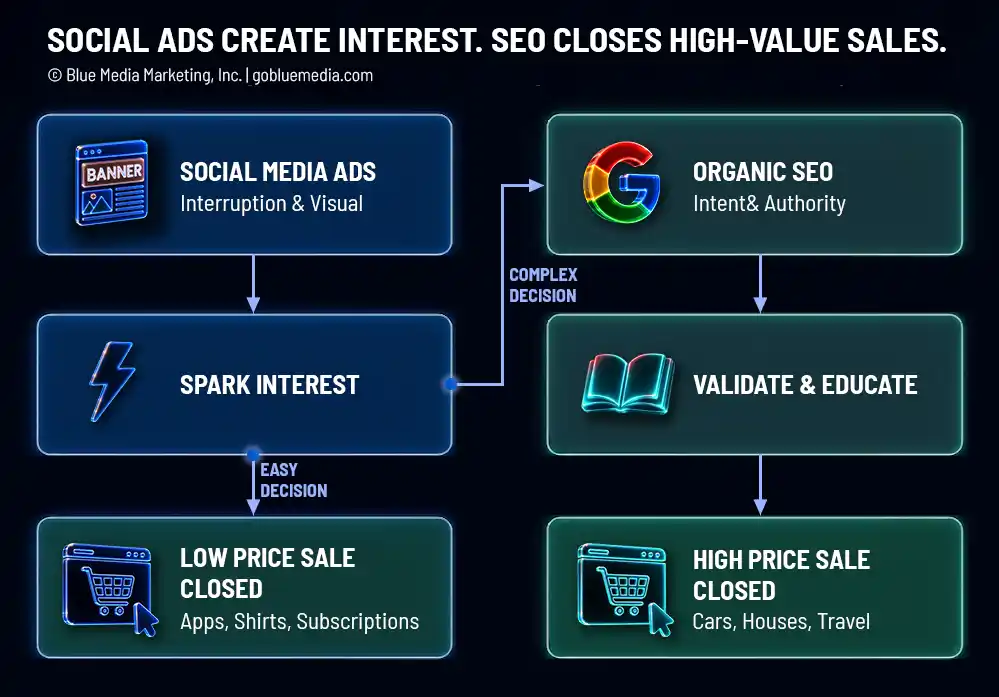
If you were to abandon SEO to Social Ads and Landing Pages entirely, it means you are paying to capture attention, but refusing to build the authority required to close the deal. For a house builder, Social Media Ads generate the spark, but SEO builds the foundation that secures the sale.
Final Recommendation: The Winning Strategy for High-Consideration Businesses
To answer our client’s original query directly: No, you should not abandon SEO for Social Media.
Doing so would mean abandoning the primary channel where customers with immediate, high-ticket buying intent go to research and select a builder.
Instead of an “Either/Or” mindset, the optimal digital marketing architecture operates as a unified funnel:
The typical Social Media to Converting Process:
- TOP OF FUNNEL (Social Media Ads & Video Content):
Captures attention, builds aesthetic desire, creates brand awareness - MIDDLE OF FUNNEL (Search Engines & AI Search):
Captures high-intent searches (Google SEO, Local Search, AI Answers) - BOTTOM OF FUNNEL (High-Converting Website Asset):
Delivers floor plans, technical specs, pricing, and captures leads