


 by
by  | Thank you for Signing Up |


SEO research goes beyond traditional processes such as keyword research and competitor analysis.
Several additional areas can play an important role in a successful SEO campaign, including Social Media Research and Social Listening.
Social Media Marketing for SEO
At Blue Media, SEO specialists are expected to understand conversions first. To fully understand the digital landscape, this also requires strong expertise in Social Media Marketing.
Social Media channels can generate traffic, increase visibility, strengthen a brand, communicate key messages, and support targeted campaigns. For this reason, Social Media strategy should be considered an integral part of a broader SEO strategy.
Before Social Media can be effectively integrated into an SEO campaign, a company needs clearly defined goals. This includes determining what the Social Media campaign should achieve, which KPIs will measure success, and which Social Media guidelines will ensure consistent quality throughout the campaign.
Learn more about Blue Media’s Social Media expertise:
Blue Media founder Dr. William Sen began working in Social Media Marketing in 2003, when the field was still widely referred to as “Web 2.0.” He later developed and engineered one of the first Social Listening tools, which was eventually used for companies including Bayer, Thomas Cook, 3M, Ford, Zurich Bank, and many others.
Dr. William Sen was also the founder of one of the first Social Media magazines and helped develop one of the earliest curricula for Social Media Studies. He later served as an associate professor in the “Social Media Manager” program at the Technical University of Cologne.
The Blue Media team has more than 15 years of experience in Social Media Marketing.
Social Listening for SEO
Social Listening, also known as Social Media Monitoring, helps companies understand how their brand, reputation, products, and services are perceived and discussed online. More importantly, it provides the insights needed to actively participate in and influence those conversations.
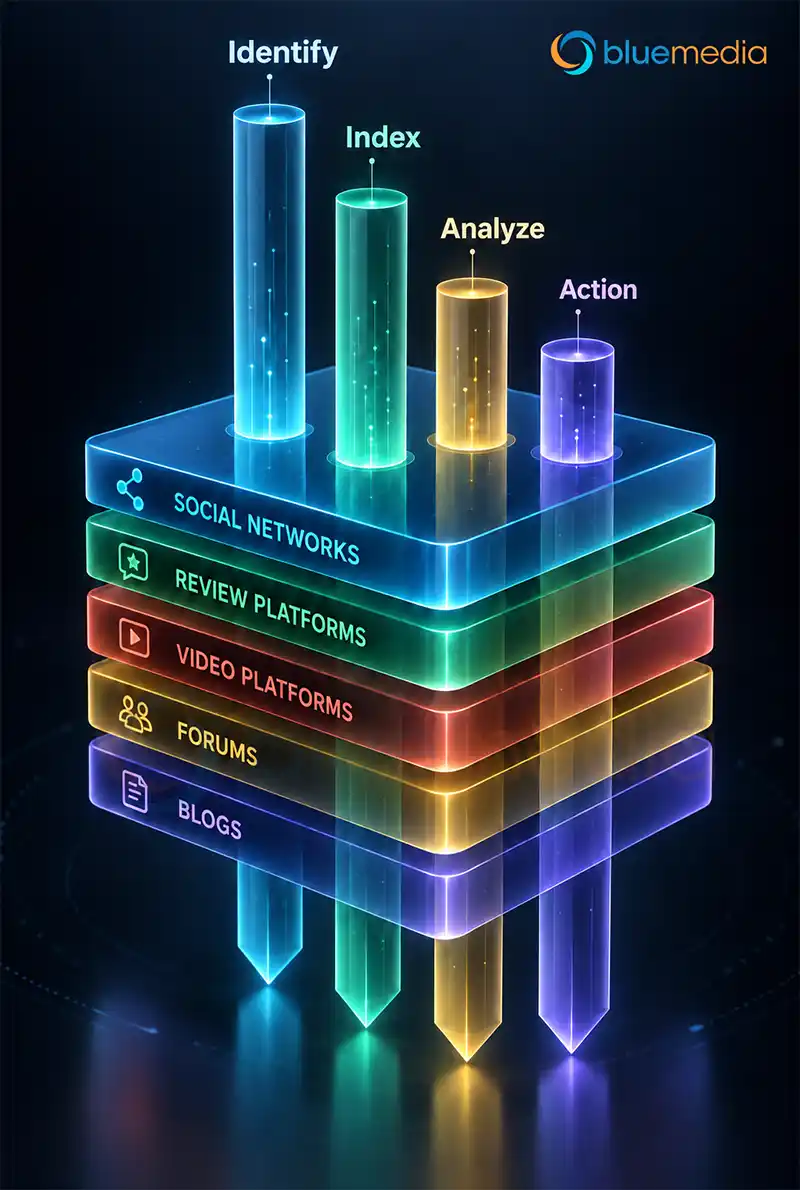
Social Listening goes far beyond simply identifying and analyzing important Social Media channels. It involves gathering and evaluating conversations across independent forums, blogs, review platforms, and social networks such as Instagram, TikTok, Facebook, X, Pinterest, and YouTube.
The purpose of Social Listening is not merely to collect information. The findings should lead to action. Companies can use these insights to strengthen their brand, improve products, manage reputation, and engage with relevant online communities through appropriate communication and Online Marketing measures.
Before meaningful action can be taken, companies first need to understand where relevant discussions are taking place, which opinions dominate the conversation, who the target audience is, and how people behave within specific online communities.
For this reason, Social Listening should consist of multiple ongoing measures rather than a simple one-time status quo analysis.
An important component of this process is Social Media Reporting.
Effective reporting transforms Social Listening data into actionable insights. Continuous monitoring and reporting can identify changes in sentiment, emerging topics, audience behavior, and opportunities for engagement. These findings can then be used to develop measures that influence how online communities perceive a company, its products, and its overall reputation.
Learn more about Blue Media’s Social Listening expertise:
The Blue Media team has been active in Social Listening since 2005 and brings extensive experience in monitoring and analyzing online conversations. Blue Media team members have advised companies on Social Media developments and produced reports identifying trends, audience discussions, emerging topics, and changes in online sentiment.
Social Listening Technology
Social Listening relies on specialized monitoring technologies to identify, collect, and analyze relevant online conversations. Fully automated Social Listening tools can create significant amounts of irrelevant data, making results difficult to evaluate and reducing their practical value.
For this reason, the most effective approach combines automated data collection with human analysis. Blue Media uses a hybrid model that combines automated indexing with manual research and evaluation. This process helps identify relevant information, remove unnecessary noise, and transform the findings into comprehensive and actionable executive summaries.
The Blue Media Monitoring Concept
The Social Listening concept below was developed by the Blue Media team in collaboration with various universities and companies.
Social Media Audits for SEO
Social Media Audits should be a continuous part of any new or ongoing Social Media campaign. One of their primary goals is to identify where the target audience is active and how that audience behaves across different platforms. For channels such as Facebook, clearly defining the target audience is especially important.
Idea Behind the Social Media Audit
If no specific Social Media channels have been selected for a campaign, a Social Media Audit can serve as target audience research. An in-depth audit should not only identify the target audience but also reveal behavioral characteristics, including content consumption habits, engagement patterns, platform preferences, and other relevant behaviors.
The purpose of a Social Media Audit is to bring structure to an otherwise complex environment. Companies are often unable to fully assess the enormous number of users, conversations, communities, and behaviors that exist across different Social Media platforms. A structured audit helps identify which areas are relevant to the company’s goals.
Why Perform a Social Media Audit?
Social Media Audits can support many different marketing initiatives. For example, they are often conducted before launching a Social Listening campaign to ensure that monitoring is based on research rather than experimentation.
Without first understanding which audiences, conversations, platforms, topics, and signals are relevant, a Social Listening campaign can become costly and inefficient. The same principle applies to SEO and Social Media Marketing campaigns.
A Social Media Audit provides the research foundation needed to understand the broader landscape of Social Media conversations before developing or expanding a campaign.
Creating a Social Media Strategy
If a company has not established specific Social Media goals, the audit should identify existing business objectives that can be used to develop a Social Media strategy. Strategies should be based on measurable business objectives rather than assumptions or intuition alone.
If no Social Media strategy exists, the auditor can evaluate the company’s broader Digital Marketing strategy. If that is unavailable, the Marketing strategy can provide additional direction. If necessary, the company’s overall business strategy should be reviewed to identify objectives that can be translated into Social Media goals.
The auditor’s responsibility is to determine which existing company strategies can support the development of an effective Social Media presence and community.
If a Social Media strategy already exists, the auditor should evaluate whether it remains aligned with the company’s current Marketing and business objectives. Existing strategies, tactics, channels, and performance can then be reviewed as part of the broader audit.
Evaluating Social Media Success
A Social Media Audit should evaluate existing Social Media channels and determine how successfully they contribute to the company’s objectives.
If a Social Media strategy is already in place, it should include measurable KPIs. These KPIs allow the audit to determine whether existing Social Media campaigns are achieving the goals established by the strategy.
The evaluation can include factors such as audience growth, engagement, traffic, conversions, content performance, reach, brand visibility, and other metrics relevant to the company’s objectives.
Continuous Social Media Audits
Social Media Audits should be performed regularly to maintain the quality, strategic direction, and consistency of Social Media campaigns.
The digital environment changes quickly. New technologies, platforms, content formats, audience behaviors, and communication trends continue to emerge. A Social Media Audit performed six months ago may already contain findings that are no longer relevant.
Conducting a comprehensive Social Media Audit therefore requires more than platform knowledge. The auditor must combine Social Media expertise with research capabilities, strategic thinking, and an understanding of broader business and Marketing objectives.
How to Find the Right Social Media Expert for an Audit?
Finding professionals who combine Social Media expertise, research capabilities, analytical skills, and strategic business knowledge can be difficult. Without these capabilities, Social Media campaigns risk being driven by assumptions rather than research, measurable objectives, and clearly defined strategies.
Blue Media provides these capabilities as an external agency. Companies do not need to build an entire internal Social Media research and strategy department to conduct a professional audit.
Our team can analyze existing Social Media activities, identify target audiences and opportunities, evaluate performance, develop strategic recommendations, and provide the research necessary to launch, improve, and maintain successful Social Media campaigns.
| Thank you for Signing Up |