


 by


The subject of “guaranteed” SEO rankings has been discussed since SEO began. Customers love to ask, “Why isn’t a certain keyword ranked number one on Google?”
It is an extremely tricky question because the word “why” suggests that SEO is about positioning a certain keyword on the first page of Google. However, this in itself is never the goal of any SEO campaign, and if an SEO tells you otherwise, run for the hills.
It’s like a judge asking a husband: “Have you stopped cheating on your wife? Simply say yes or no.” If you say “yes,” you admit that you cheated on your wife. And if you say “no,” you admit that you are still cheating on her.
And that’s why this SEO question is one of the most difficult questions to answer if you’re an SEO expert.
Let’s get down to it:
SEO never was and never will be about bringing one keyword or a set of certain keywords to the first position on Google.
It’s Not Your Fault, Client!
 Seriously, it’s actually not the client’s fault. The promise is sweet music to a client’s ear because they would love to hear that an SEO expert will bring them to position one on Google with a keyword of their liking.
The question is usually caused by the fact that some SEO agencies promise exactly this to their clients — mostly offshore SEO companies specializing in spam and fraudulent deals built around the promise of “How to be number one on Google.”
The client might also have seen that promise in SEO ad banners, probably while browsing some shady websites.
Another interesting discovery is that website development companies, which are seldom SEO experts, sometimes make these promises — giving the impression that SEO is about positioning a keyword on top of Google. Basically, the promise of ranking #1 is used as a sales phrase very often. And the worst offenders: someone who refers a client to an SEO expert or a company saying “I know a guy who can do that”.
And the whole SEO campaign starts with the wrong idea and expectation.
Some SEO agencies are downright ill-informed about good practices in this field. Sometimes they use crooked means to help a site rank. But Google’s engineers work every day to neutralize such tactics, so they never last as Google improves its algorithms and search results.
The fact is that no professional SEO company would ever promise you such a thing.
So, what is SEO all about then?
SEO is about driving traffic to your website, increasing your brand awareness by providing visibility on the web, in order to support your conversion efforts such as increasing sales.
If you think that positioning one keyword on top of Google will help you with this, then you might be missing the whole point of SEO.
Why Positioning a Top Keyword is Worth Nothing in the End
Sometimes people and clients are obsessed with certain keywords. That happens. They want to see their website with one keyword on top of Google. Clients often don’t know that rankings of one or two keywords are not a metric to measure the success of Search Engine Optimization.
Let me explain.
Let’s say you are a coffee machine manufacturer, and the keyword you have set your heart on is “Best Coffee Maker“.
Sure thing, having this keyword on top of Google associated with your website might fill you with excitement. However, have you ever considered that the first page of Google only lists about 10 organic results? And today, ads, AI Overviews, and other search features often push them even further down. It’s something to think about!
The first thought is, what makes you think that you are the one that deserves to be positioned there among hundreds of millions of other websites? Among them, not just the competition worldwide, but also millions of forums, blogs, and social media posts about the best coffee makers.
And let’s not forget about the thousands of well-known top-rated and ranked online magazines, news portals, and TV broadcasters that also try to rank for keywords like these with their posts. Now imagine an SEO gave you a promise like that. How serious can such a promise be? Nobody has control over Google like this.
Another thing: no SEO agency can predict the constant algorithm changes that happen on a daily basis. Google now even tailors results specifically to users and their search history, meaning your website could rank in position #1 for one person, and #4 for another based on their personal preferences and a host of other factors.
This is why it is worth nothing.
So, what do you do now?
The second thought should be, if you really wanted to be ranked with that keyword on the first page, how much budget would you have to spend for SEO? Are you willing to spend tens of millions of dollars in order to have tens of thousands of backlinks, articles, and comments from users on your website?
Because this is what your website would have to become to have the slightest chance of getting listed for one specific defined keyword.
And even then, in theory, if it somehow makes it – how long do you think you can maintain that position? As we know, keyword positions are subject to changes that Google makes every day. Would you spend $10 million to be on top of Google for one week for just one keyword? There is so much that you need to pair with user engagement, authority, and reputation.
Ranking for one or two keywords alone lacks substance. This is even more true today, as AI Overviews and AI assistants answer many generic questions directly, without users ever clicking on a search result.
Wonders Happen
Sometimes, websites do rank for the one keyword they were aiming for. Admittedly, the nature of rankings is that they fluctuate. For instance, the search engine result query may change or reorder a result. That’s why SEO experts stay away from that promise.
I have managed SEO campaigns where the focus was also on one keyword. But we made all other efforts in parallel and always considered the possibility of having that one keyword on top as a bonus. Eventually, it happened.
However, looking back, this was one of my longest SEO campaigns, lasting 12 years. The website I was maintaining eventually became the biggest resource for that keyword. On top of that, we were the first ones to publish content around that keyword. Keep in mind that this SEO campaign had started more than 12 years earlier! That’s why it was ranked that high.
This is the moment where you have to ask yourself: What is it with this keyword obsession?
Why Top Keywords are Not Enough
Now let me explain why even one keyword is sometimes not worth much. For this we have to look at the search volume for this example “Best Coffee Maker”:
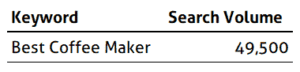
As you can see, the monthly search volume for “Best Coffee Maker” was 49,500 at the time of writing. Even if you think it’s the most important keyword for this exemplary coffee business, it’s actually not as much as you think.
So, let’s have a look:
Benefits of Long-Tail Keywords
Real, professional SEOs try to rank for a huge variety of so-called long-tail keywords. They usually create a keyword funnel inside your website with hundreds, if not thousands of keywords. The tail of keywords goes on and on.
They don’t try to rank for only a few keywords with fierce competition. Less competition increases your chances of ranking higher. Believe it or not, with the right SEO Keyword Strategy, eventually, you will be positioned on the first page of Google over time with different keywords from your space. And that’s where the traffic comes from.
Placing and betting on one keyword is like playing the lottery. Only a few can win. But a professional SEO campaign would rank thousands of keywords which will increase the chance of you being listed on top of Google.
Let’s take our example business “coffee maker” and take a look at long-tail keywords.
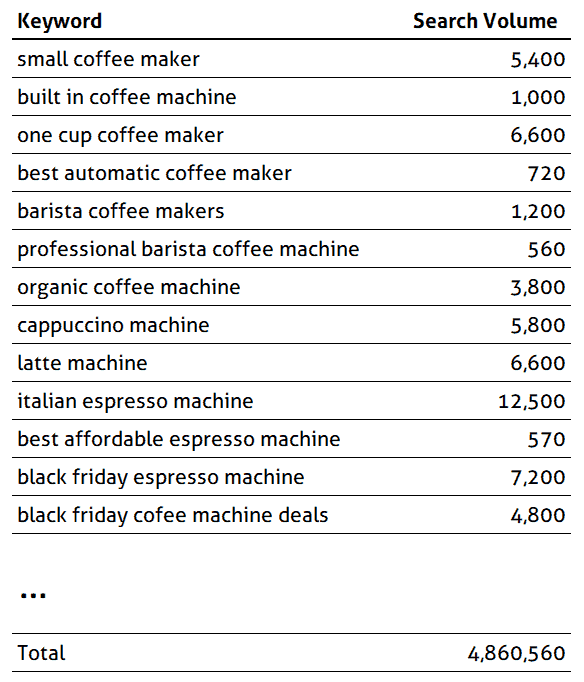
As you can see, the coffee making business offers more than 4.8 million searches around coffee machines every month. If you captured only 2% of these keywords, you would have way more traffic than “best coffee maker”.
Besides, having a diverse group of keywords ranking will also ensure that losing positions for certain keywords won’t hurt you much, as other keywords will gain positions at the same time.
One other aspect of having more keywords is that you can try to position yourself with keywords that are in 100% alignment with your product. If you have some features and specifics about your service or product, you might want to rank for them.
On one hand, the competition may not be aiming for these kinds of specific keywords which gives you better leverage on Google. And on the other hand, driving users to your website with specific demands will result in much higher conversions and brand awareness, rather than generic top keywords.
And the most important reason for this long-tail keyword strategy: it works, whereas the other strategy with one keyword is better left in the bin.