
 by
by For most of the internet’s history, search engine optimization behaved like engineering maintenance. Pages were tuned, metadata refined, keywords inserted, links acquired. The job was to help a machine retrieve a document more confidently than competing documents.
That model depended on a simple reality: search engines returned lists.
A user searched, ten blue links appeared on classic search engines, and visibility depended on relative positioning. The difference between first and fifth place mattered because the user decided which source deserved attention. SEO therefore revolved around influence inside a ranking system. Improve signals, improve position, earn clicks.
AI Removes the List
Search increasingly answers instead of pointing. A system interprets a question, constructs a response, and integrates information from sources it considers reliable. The decisive moment no longer happens on the results page. It happens inside the explanation.
This single shift ends Classic SEO as a self contained craft. You cannot meaningfully optimize a page for a system that does not primarily evaluate pages.
AI evaluates understanding.
From Retrieval to Interpretation
Traditional search compared documents.
AI compares meaning.
Instead of matching a query to a page, the system builds a model of the world and selects which organizations help it explain that world coherently.
A ranking system rewards relevance in context of other pages. A reasoning system rewards consistency across an entire organization.
If a company describes itself differently across channels, publishes disconnected material, or communicates expertise inconsistently, a human reader might still evaluate each page separately. An AI system does not. It attempts to form a stable representation of the entity behind the information. When that representation remains unclear, the system avoids relying on it.
The practical consequence is subtle but profound. Visibility no longer depends primarily on improving individual content assets. It depends on whether a machine can confidently understand what a company is, what it knows, and when it should be referenced.
In other words, search stops measuring documents and starts measuring identity.
Search as Strategy
Because understanding now matters more than isolated relevance, SEO moves upward in the organization. It cannot remain a late stage marketing activity concerned with traffic acquisition. It becomes a structural property of the business.
A company that builds a product one way, markets it another way, and explains it a third way creates interpretive friction. Humans can tolerate that inconsistency when they look at only one source. AI systems cannot as they look at the big picture and the message as a whole.
Search performance therefore emerges from alignment. Product definition, messaging, customer education, and public discussion must reinforce the same idea consistently. When they do, the organization becomes easy to model. When it is easy to model, it becomes easy to cite.
This is why search becomes strategy. The objective shifts from attracting visitors to becoming the expected source of explanation. Instead of asking how to rank, organizations must ask whether their knowledge is structured clearly enough to be understood without ambiguity.
SEO begins influencing decisions long before content is produced. It shapes how offerings are described, how problems are framed, and how expertise is communicated across the company. The work resembles editorial direction and product positioning more than technical adjustment.
Designing the Search Ecosystem
In the era of lists, competition happened on a page. In the era of synthesized answers, competition happens in a knowledge environment.
AI systems learn patterns across time and across platforms. They observe whether a brand consistently explains a topic, whether audiences interact with that explanation, and whether other sources reference it.
An effective search ecosystem forms when multiple signals converge: recurring explanations of the same ideas, consistent terminology, educational material that deepens rather than repeats, audience engagement that demonstrates comprehension, and third party discussion that confirms relevance. Each element reinforces the others until the organization becomes associated with a concept rather than a collection of pages.
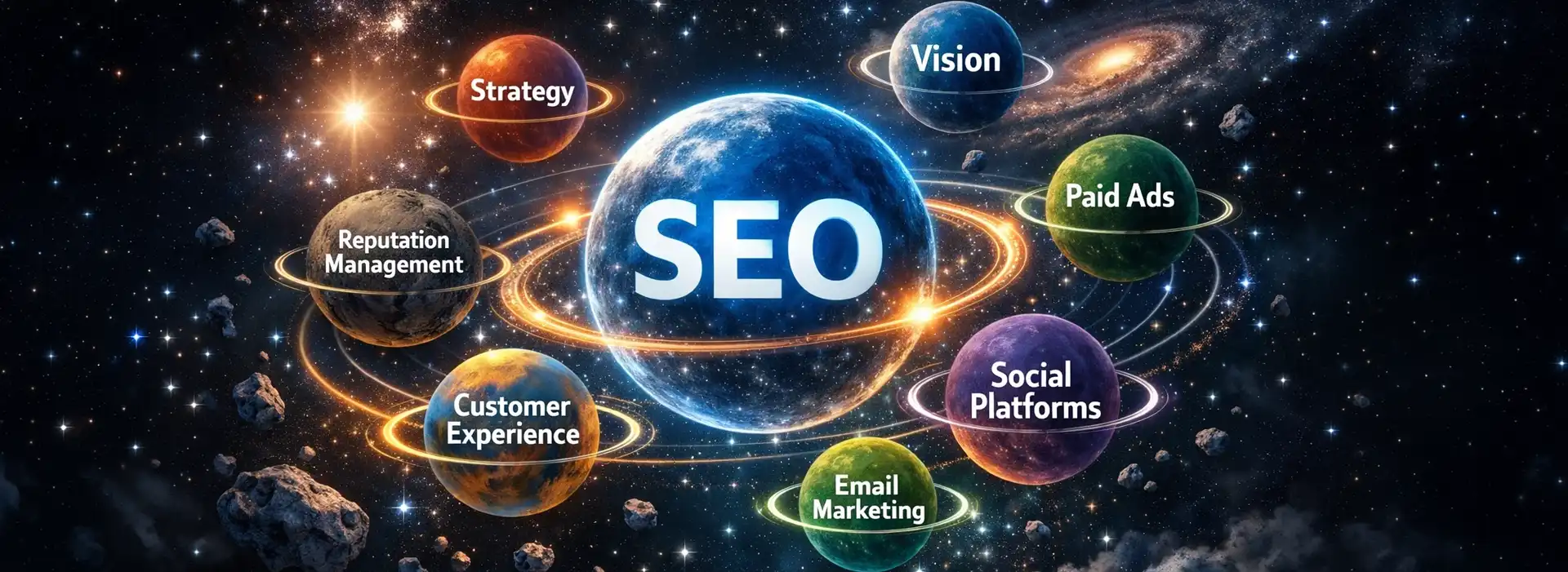
The role traditionally called SEO changes accordingly. Instead of optimizing pages, SEO experts must design informational environments that provide understanding. They coordinate content, social communication, product language, and public discourse so that the same narrative appears everywhere when a machine looks for meaning.
The goal is no longer visibility in results. The goal is presence in reasoning.
Why Best Practices Stop Producing Advantage
The previous search era rewarded repeatable improvements. Shared guidelines created predictable gains because each site competed independently. If many organizations followed similar optimization methods, they still occupied different positions in a list.
AI synthesis removes that separation. When multiple sources say similar things in similar ways, the system compresses them into a single interchangeable reference.
Competitive advantage in SEO moves away from execution quality and toward conceptual ownership. The winning organization is not the one that optimizes best but the one that explains something uniquely well and consistently throughout all channels they serve. And only then optimization improves performance inside the internet.
From Keywords to Knowledge
Keywords once described what people searched for. Now systems attempt to understand what people mean. Frequency matters less than clarity of explanation across contexts. A single page repeating a phrase cannot compete with an organization that repeatedly teaches an idea in different forms.
In practical terms, companies have to stop targeting queries and start shaping content. They introduce language the industry adopts, frameworks audiences reuse, and explanations competitors must respond to. Search visibility becomes a consequence of conceptual and consistent messaging.
The emerging discipline resembles environmental design more than classic optimization. Instead of competing within demand, organizations influence how demand is formed and interpreted by machines holistically.
A Different Measure of Success
Traditional metrics captured exposure: impressions, clicks, and position. In AI now mediates discovery, recognition becomes more revealing than traffic.
Organizations observe whether they are mentioned in generated explanations, whether audiences search for them directly, and whether comparisons decrease because understanding increases. These signals indicate that the system and the market both recognize the entity as a stable source of knowledge.
Traffic may even decline while influence grows, because answers resolve questions earlier in the decision process. The absence of a click does not necessarily mean absence of impact and conversions. It may mean the brand was trusted before a visit became necessary.
The Future of SEO
SEO does not disappear. It changes.
Instead of improving pages, it has to improve comprehensibility. Instead of influencing ranking systems, it has to shape knowledge. Instead of functioning as a marketing tactic, it has to become a layer between strategy, communication, and education.
The organizations that adapt will not treat search as a channel to capture traffic. They will treat it as a reflection of how clearly they define reality within their field.
Classic SEO belonged to the age of retrieval.
AI belongs to the age of interpretation.
The companies that thrive will not be those that perfect technical adjustments. They will be those that design themselves to be understood.